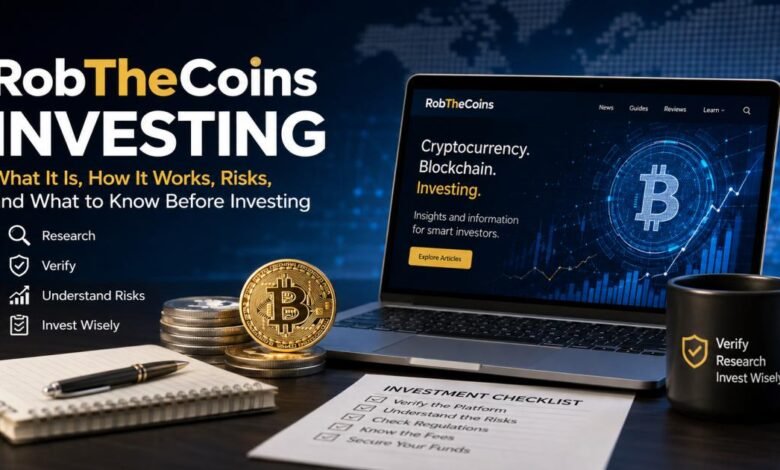
RobTheCoins investing is not one clear, single thing. The name shows up online in two different ways. One is an educational blog that publishes articles about cryptocurrency and investing. The other is a label attached to separate platform-style pages that describe trading, staking, or wallet features. This article breaks down both meanings. It shows you how to tell them apart. And it gives you a working checklist to use before you send money to anything called “RobTheCoins.”
If someone sent you this term through an ad, a social media post, or a direct message telling you to invest through RobTheCoins, skip ahead and read “Important Distinction” first.
Introduction
A lot of people search “robthecoins investing” for one of two reasons. Some want a plain explanation of crypto and investing basics, and they found an article with this name on it. Others heard the name somewhere — a friend, a paid ad, a Telegram group. They want to know if it’s safe to put money into it.
Both groups deserve a real answer. That answer is more complicated than a simple yes or no. Here’s why.
Is RobTheCoins an investment platform, a cryptocurrency, or an information website? Based on the evidence, RobTheCoins exists most clearly as a content website. It’s a blog that publishes articles about crypto, investing, and personal finance. Its About page says directly that it does not give financial advice. At the same time, a separate group of online articles describes something closer to an actual trading platform, with claims about sign-ups, staking, and dashboards. These two things don’t line up as one confirmed entity. No single search result settles where one ends and the other begins.
This article was built the way any careful review should be. It starts with the RobTheCoins site’s own pages. Then it works through a wide range of third-party articles that use the name. Then it checks independent, non-promotional sources. Then it compares red flags against guidance from consumer protection agencies. When the evidence is thin or contradicts itself, that gets said outright instead of smoothed over.
Important Distinction
Here’s the one thing to understand before anything else: “RobTheCoins” doesn’t reliably point to one company, app, or investment offer. Different websites and domains use variations of this name for different things. An educational blog. A described “business” opportunity. A claimed cryptocurrency. A described trading platform. All of these rank under this name in search. If someone sent you to a specific site or offer using this name, check that exact service on its own terms before you deposit anything. Nothing here confirms the safety, legitimacy, or identity of any particular site you were sent to.
This article does not call RobTheCoins investing a scam. It also does not call it a safe, legitimate investment platform. The evidence doesn’t support either verdict. What follows is an honest breakdown of what can and can’t be confirmed, plus a method you can use to check any specific offer yourself.
What Is RobTheCoins Investing?
What the RobTheCoins Website Says It Is
The clearest primary source here is the About page on the RobTheCoins blog. It describes the site as an informational publication in plain language. It states that it does not provide financial, legal, or investment advice. It says content is for educational purposes only, and that readers should do their own research and talk to qualified professionals before making financial decisions. The stated goal is to explain crypto, investing, business strategy, and financial news in terms that are easy to follow.
That is a different claim than “we manage your investments” or “we help you trade crypto.” A site that calls itself educational and openly says it gives no advice is describing a publisher. Not a brokerage. Not an exchange. Not a fund manager.
Is RobTheCoins an Investment Platform, Exchange, or Cryptocurrency?
Based on the strongest evidence available, the core RobTheCoins blog is not an exchange. It’s not a wallet provider. It’s not a cryptocurrency. You can’t use it to buy, sell, or hold any digital asset. There’s no order book, no trading engine, and no custody function described anywhere on its own About page.
That’s not the full story, though. This is where honesty matters more than a tidy answer. Search results for this name also surface pages that describe something else entirely: sign-up flows, staking features, wallet access, “getting started” steps, and trading tool claims. These pages don’t agree with each other. Some describe a content site. Others describe what reads like a working trading platform. A few use the name for an alleged token or coin. None of these platform-style claims come with the detail an outside reader would need to check them. No named legal entity. No license number. No regulator to compare the claim against.
The honest read is simple: this name gets used inconsistently across the internet. A search result using this term doesn’t tell you, by itself, which version you’re looking at.
Why the Name “RobTheCoins Investing” Can Be Confusing
A few things make this particular name harder to pin down than most brand names.
First, it’s a catchy, generic-sounding phrase built on a common crypto pun. That makes it easy for unrelated sites to reuse. Second, a large share of the content using this name repeats similar phrases — “structured framework,” “smart strategy,” “combines education with tools” — without tying any of it to a fact you can check, like a company registration or a named executive. When the same vague claim shows up on ten sites, it’s tempting to read that as ten confirmations. Often it just means one unverified claim got copied and rewritten ten times. Third, the underlying blog covers investing as a topic, so its articles rank for investing-related searches. That pulls in readers looking for somewhere to invest, not somewhere to read about investing.
How Does RobTheCoins Investing Work?
How the RobTheCoins Content Model Works
Where a clear picture exists, RobTheCoins runs as an editorial content operation. Articles are published under named authors. They sort into topic categories. They follow a standard structure: an introduction, a few explanatory sections, and often a closing summary or FAQ.
The topics covered span a fairly wide range within finance and technology:
- Cryptocurrency — plain explanations of coins, tokens, and how digital currencies work
- Blockchain — how the underlying technology functions and where it gets used
- Investing — general strategy topics like diversification, risk management, and long-term planning
- Digital assets — broader coverage of things like NFTs and tokenized assets
- Related financial technology — fintech tools, apps, and emerging platforms
None of this touches anyone’s money on its own. It reads closer to a financial literacy publication than a financial service.
What You Can and Cannot Assume From the Website
A lot of the confusion around this name comes from readers assuming more than the evidence supports. A direct comparison makes the gap clear.
| Question | What the evidence shows | What should not be assumed |
|---|---|---|
| Is there investing-related content? | Yes | That the site manages investments |
| Does the brand discuss crypto? | Yes | That it operates an exchange |
| Does content discuss investment strategies? | Yes | That readers receive personalized financial advice |
| Is there a specific investment product? | Verify separately | Don’t assume one exists |
| Is it a regulated investment platform? | Verify exact entity/service | Don’t claim regulatory approval without evidence |
That pattern repeats through nearly every part of this topic. Content about a subject is not a service related to that subject. It’s worth pausing on that distinction each time a new claim comes up.
Who Is Behind RobTheCoins?
What the RobTheCoins About Page Says
The About page frames the operation as a “modern digital publication.” Its stated purpose is to help readers navigate cryptocurrency, investing, business strategy, and financial news. It describes a mission built around financial literacy, and it says content is researched to show multiple perspectives. Some RobTheCoins content is published under an individual author byline on article pages. But a full public profile — professional background, credentials, or a prior track record — isn’t consistently published alongside that name.
What Can Be Independently Verified?
This is where the gap between marketing language and verifiable fact shows up most clearly. A wide range of articles using the RobTheCoins name make confident claims. That it’s trusted by “smart investors.” That it runs a proven system. That it offers institutional-grade tools. None of the material reviewed for this article ties those claims to facts you can check, such as:
- A registered legal company name and jurisdiction
- A named leadership team with a real, checkable professional history
- A regulatory license number you can look up on an official register
- Third-party audited financials or a verifiable user base
That absence doesn’t prove wrongdoing by itself. Plenty of small blogs skip this level of corporate detail, because they aren’t offering a regulated financial service in the first place. But the moment any version of “RobTheCoins” asks you to deposit money, that absence stops being a minor gap. It becomes the central question you need answered.
Why Ownership and Financial Authority Are Different Things
Two ideas get blurred together here: who owns or publishes a website, and who has the authority to handle other people’s investments. Running a blog needs no license. Managing client money, running an exchange, or offering securities usually does — the exact rule depends on the jurisdiction and the activity involved. A confident “About Us” page answers the first question. It tells you nothing about the second. If a specific RobTheCoins-branded offer asks you to fund an account, answer the ownership question and the licensing question separately. Never assume one from the other.
Is RobTheCoins Investing Legit or Safe?
What “Legitimate” Actually Means
“Legitimate” gets used loosely, so it helps to define it first. In a financial context, legitimacy rests on a few concrete things. The entity behind a service is clearly identified. It operates within the law for the activity it performs. Any regulatory registration it claims can be checked independently. Its terms, fees, and risks are disclosed, not hidden. A service can be legitimate and still risky. A service can also look polished and still fail every one of these tests.
Is RobTheCoins Regulated?
Based on the material reviewed, there is no public, checkable evidence that any version of “RobTheCoins” holds a financial license. That includes a securities registration or a money transmitter authorization, in the United States or anywhere else. The core content blog doesn’t claim to be regulated. That fits its own description as an informational publisher — publishers typically don’t need this kind of license. Separate platform-style pages using the name don’t show a checkable license number or regulator name either.
If you’re looking at a specific RobTheCoins-branded product that claims regulatory approval, don’t take that claim at face value. Check regulatory status directly on the relevant regulator’s own public register. Use the exact legal company name, not just the brand name.
Is RobTheCoins Safe for Investors?
Given the gaps above, the responsible answer is that safety can’t be confirmed either way from the outside. That uncertainty is itself the finding worth taking seriously. Read purely as reading material, the content blog carries the same general risk as any other unverified financial blog. Don’t treat its explanations as personal advice. Check any factual claim before you act on it. Any platform-style offer using this name carries much higher uncertainty. It involves your money directly, and none of the standard trust signals — licensing, named leadership, audited operations — show up clearly in public information.
RobTheCoins Investing Risks You Should Understand
Whether you’re reading RobTheCoins content casually or looking at a specific investment offer tied to the name, the underlying subject — cryptocurrency — carries real risks. Those risks exist no matter which brand is attached to them.
Cryptocurrency Market Volatility
Cryptocurrency prices can move sharply within hours, not just over weeks or months. This volatility runs in both directions. It isn’t proof of a healthy or well-managed market on its own — it’s just a structural feature of thinly traded, sentiment-driven assets. A coin or token can lose a large share of its value fast. In some cases, a project fails, and its value drops to zero. Past price gains, even dramatic ones, are not a preview of future returns. Markets that climb fast have also crashed fast, often for reasons nobody saw coming.
Fraud connected to this volatility is not rare. The FBI’s Internet Crime Complaint Center recorded 181,565 cryptocurrency-related complaints in 2025. Reported losses passed $11.3 billion, and roughly $7.2 billion of that came from investment fraud alone. Those figures aren’t tied to RobTheCoins by name. They show why any unfamiliar crypto brand, platform, or project needs careful checking before you send it money.
Platform and Counterparty Risk
Any time you hand money or crypto to a third party — an exchange, a platform, a “manager” — you take on counterparty risk. That middleman could go insolvent, get hacked, mismanage funds, or just disappear. If it does, your chance of getting your money back depends on what protections were actually in place. It does not depend on what was promised. Before you use any platform, get a clear answer to one basic question: if this company fails tomorrow, what happens to my funds? If nobody can answer that clearly, that’s your answer.
Custody and Wallet Risk
“Custody” means who actually controls the cryptographic private keys tied to an asset. Control of those keys is control of the asset itself. A hot wallet, connected to the internet, is more convenient but more open to hacking. A cold wallet, kept offline, is safer but less convenient. When you deposit crypto onto an exchange or platform, you usually hand custody to that platform instead of holding it yourself. That means your access depends on their systems and their solvency. Crypto transactions are also usually final: once you send funds, there’s typically no bank or company that can reverse the transaction, even if it was a mistake or a fraud.
Fraud, Impersonation, and Fake Investment Websites
Crypto has a well-documented fraud problem, and brand confusion like this is one of the tools fraud relies on. Common patterns include:
- Fake platforms built to closely copy a real or well-known name.
- Fake customer-support accounts on social media or messaging apps that respond fast and helpfully, right up until money gets requested.d
- Impersonation of real people, companies, or brands to borrow their credibility
- Fake testimonials presented as independent user reviews
- Fake account balances shown on a dashboard that don’t match any real, withdrawable funds
- Phishing messages built to steal login credentials or private keys
- Social-media investment pitches that create urgency and rely on unsolicited outreach
None of this list is a claim about RobTheCoins by name. It’s a description of how fraud typically works in this space, which is exactly why brand confusion matters so much here.
Withdrawal and “Fee” Scams
One of the most common patterns in crypto fraud shows up at withdrawal time. A platform shows a growing balance. But when you try to withdraw, you’re told to pay something extra first. Maybe it’s an unexpected withdrawal fee. Maybe it’s a claimed “tax” payment, an “unlocking” fee, or a new deposit that supposedly unlocks your profits. Legitimate platforms typically don’t ask for new deposits to release funds that are already supposedly yours. A request like this, arriving right when you try to take money out, is one of the clearest warning signs in the fraud playbook.
Regulatory and Legal Risk
Beyond fraud, there’s a quieter risk. Using an unregistered or unlicensed platform can leave you with little or no legal recourse if something goes wrong, even if that platform never technically defrauds anyone. Regulated financial platforms usually have to hold client funds in specific ways, undergo audits, and offer a dispute process. Unregulated platforms may offer none of that, no matter how good their marketing looks.
RobTheCoins Investing Red Flags to Watch For
If you’re looking at an offer connected to this name, or any similar crypto opportunity, treat these signals as an immediate pause.
Guaranteed or “Risk-Free” Returns
No legitimate investment, crypto or otherwise, can honestly guarantee a return. Markets move up and down. A claim of guaranteed profit, or language calling an investment “risk-free,” doesn’t match how investing actually works.
Pressure to Invest Immediately
Real investment opportunities don’t usually vanish in the next ten minutes. Urgency — countdown timers, “limited spots,” a bonus that expires today — is a pressure tactic. It’s built to short-circuit careful thinking. It isn’t a normal feature of a well-run financial offer.
Unusually High or Consistent Returns
Real markets are volatile. A platform claiming steady, predictable daily or weekly gains, especially at a rate well above what established markets typically produce, deserves heavy skepticism, not excitement.
Requests to Send Cryptocurrency Directly
Being asked to send crypto straight to a personal wallet address is a red flag. It skips the documented, checkable process an established platform would use. That removes most of the safeguards you’d have elsewhere in finance.
Unclear Company Ownership
If you can’t find a real legal entity name, a jurisdiction, and a way to independently check who’s behind an offer, that’s not a small gap. It’s the single most important piece of missing information before you send money anywhere.
How to Verify a RobTheCoins Investment Opportunity Before Depositing Money
This is the most practical part of this guide. It applies whether the offer in front of you uses this brand name or any other. Work through these steps in order.
Step 1 — Confirm the Exact Website or App
Check the exact spelling and full domain of whatever you were sent to, character by character. Watch for extra letters, hyphens, or lookalike domains built to resemble a more familiar name. Don’t rely on a search-result snippet or a shared link’s preview text alone. Open the actual site and check the address bar yourself.
Step 2 — Identify the Legal Company
Look for a full legal company name, not just a brand name. Look for a registered jurisdiction, a real business address, named directors or managers, and working contact information. If this information is missing, buried, or vague, treat that as a serious gap. Don’t look past it.
Step 3 — Verify Regulatory Claims
U.S. readers can check claims against resources like Investor.gov, run by the SEC, and FINRA’s BrokerCheck where it applies. Readers outside the U.S. should check their national financial regulator’s public register. A claimed license means very little until you’ve confirmed it yourself on the regulator’s own site. Never rely only on a badge or logo shown on the platform itself.
Step 4 — Understand Exactly What You Are Buying
Get precise about what’s actually on offer. Is it cryptocurrency? A security? An investment contract? A managed account? A trading service? Or is it, in reality, just educational content? Each of these carries different rules, different risks, and different protections. Vague marketing language often blurs this line on purpose.
Step 5 — Find Out Who Controls Your Money or Crypto
Ask directly: who holds custody of my funds? Who controls the private keys? What are my actual withdrawal rights, in writing? Who is the counterparty on the other side of my funds? If you can’t get clear, written answers before you deposit anything, that’s your answer about whether to proceed.
Step 6 — Check Fees and Withdrawal Rules Before Depositing
Look for a full breakdown of deposit fees, trading fees, and withdrawal fees. Check for a stated minimum withdrawal amount and any conditions tied to withdrawals. Do this before you put money in, not after. Fee structures that only become clear at withdrawal time are a common source of disputes.
Step 7 — Search for Independent Complaints and Regulatory Warnings
Search the exact company name and domain on their own. Then search “[company] review,” “[company] complaint,” and “[company] scam.” Check regulator databases directly too, since some regulators publish warning lists for unregistered platforms. Ten positive-sounding articles repeating the same vague phrases matter far less than one specific, detailed complaint or one regulatory warning. IC3 logged over 181,000 crypto-related complaints in a single year. Skipping this step isn’t a shortcut — it’s a real gamble.
Step 8 — Never Invest Because of FOMO
Fear of missing out is one of the most reliable tools fraud relies on, precisely because it works even on cautious people. Give yourself real time — days, not minutes — to work through the steps above. A genuine opportunity still exists tomorrow. Pressure to skip this step is, on its own, a reason to slow down further.
RobTheCoins Investing vs. a Regulated Investment Platform
| Feature | RobTheCoins as an information source | Regulated investment provider |
|---|---|---|
| Primary purpose | Education/content | Financial services |
| Holds customer assets | Verify; don’t assume | Depends on provider |
| Executes trades | Verify | Depends on provider |
| Regulatory obligations | Verify applicable status | Depends on entity/activity |
| Personalized advice | Don’t assume | Depends on licensing/service |
| Investor protections | Must be independently verified | Depends on product/entity |
The pattern in that table stays the same: a regulated provider’s duties are set by law, and you can check them against a specific license. An information source’s duties are mostly whatever it says about itself. That’s exactly why independent checking matters so much more once real money enters the picture.
Who Is RobTheCoins Investing Suitable For?
Potentially Useful For
Read purely as educational material, RobTheCoins-branded articles can work as a starting point. They’re useful for absolute beginners who want plain-language explanations of terms like blockchain, volatility, or diversification. Think of it as an entry point, not a source of specific financial decisions. This kind of general content can help someone build vocabulary before they seek out licensed, personal advice elsewhere.
Not a Substitute For
This content, and content like it, is not a substitute for licensed financial advice built around your situation. It’s not a substitute for independently confirming the identity and regulatory status of any platform before you deposit money. And it’s not a substitute for professional tax or legal guidance once real financial consequences are on the table.
How to Use RobTheCoins Content Responsibly
Treat Educational Articles as a Starting Point
General explainer content builds background knowledge. It doesn’t make specific financial decisions for you. Use it the way you’d use an introductory textbook chapter: for orientation, not instruction.
Cross-Check Important Claims With Primary Sources
Any specific factual claim — a statistic, a regulatory status, a historical price figure — is worth checking against a primary source. A regulator’s own site. An official market data provider. A peer-reviewed source. Don’t accept a claim just because it sounds confident in an article.
Don’t Confuse Information With Financial Advice
Reading about diversification is not the same as getting advice about how you, specifically, should diversify. Keep that line clear in your own mind, even when an article’s tone sounds personal and direct.
RobTheCoins Investing: Pros and Cons
Potential Advantages
- Free, easy-to-follow explanations of basic crypto and investing concepts for newcomers
- A stated editorial mission around financial literacy, with a plain disclaimer that it isn’t financial advice
- Broad topic coverage, from blockchain basics to general investing strategy
Limitations
- Inconsistent use of the brand name across the internet makes it genuinely hard to know which specific service, if any, you’re dealing with
- No independently checkable regulatory status for any platform-style offer using this name
- No consistently published, checkable information about who owns or runs platform-style versions of the brand
- Some independent reviews report user complaints about withdrawals and unclear revenue sources tied to business-style offers using this name.
- Content quality and depth vary a lot across the many sites using this branding.g
Final Verdict
RobTheCoins investing is best understood as a name attached to genuinely educational content about cryptocurrency and investing. By its own published description, that content is not financial advice and does not manage anyone’s money. The same name also gets used, inconsistently and with no clear connection, by other online material that describes platform-style features. Those features can’t be independently checked from available evidence.
The right takeaway isn’t a verdict of “scam” or “legit.” It’s a discipline. Treat the educational content as a starting point for learning. Treat any platform, app, or investment offer using this name, or any name, as something that has to earn your trust with checkable facts before it earns your money. Confirm the exact website. Identify the legal entity behind it. Check any regulatory claims directly with the regulator. Understand exactly what you’d be buying and who would control it. Crypto-related fraud losses passed $11 billion in a single year, according to federal complaint data. That kind of verification isn’t excessive caution — it’s the baseline. If those questions can’t be answered clearly and in writing, that’s reason enough to walk away, no matter how polished the pitch sounds.
FAQs
What is RobTheCoins investing?
RobTheCoins investing is a term used online in more than one way. Most clearly, it refers to content published by an educational blog about cryptocurrency and investing. The same term also describes platform-style features on separate pages. Confirm which specific site or service you’re looking at before you assume either meaning applies.
Is RobTheCoins a cryptocurrency?
No verified, independently confirmed cryptocurrency or token is officially and exclusively tied to this name. If you’ve seen a specific token using this name, check its blockchain, contract address, and issuer yourself before treating it as connected to any established brand. Scammers routinely launch tokens using recognizable names to borrow their credibility.
Is RobTheCoins an investment platform?
The core content blog is not. It describes itself as informational and says it does not manage investments. Separate pages using the same or a similar name describe platform-style features, but those claims aren’t independently checkable from the evidence reviewed here. Don’t assume they’re part of the same operation.
Is RobTheCoins legitimate?
There’s no single yes or no here, and any article that gives you a confident one-word answer either way is oversimplifying. The content blog’s own description of itself as an educational publisher holds together. Platform-style claims using the name lack the checkable detail — legal entity, licensing, named leadership — needed to call them confirmed legitimate.
Is RobTheCoins safe?
Reading the educational content carries the same general risk as reading any other unverified financial blog: treat claims as a starting point, not a final answer. Depositing money into any platform-style offer using this name carries much higher risk, given the lack of checkable ownership and regulatory information. That shouldn’t happen until you’ve finished your own verification.
Is RobTheCoins regulated?
There’s no public, checkable evidence of financial regulatory registration or licensing tied to this name. If a specific offer claims to be regulated, check that claim directly on the relevant regulator’s own public register before you rely on it.
Does RobTheCoins provide financial advice?
No. The core blog’s own About page states directly that it does not provide financial, legal, or investment advice, and that its content exists for informational and educational purposes only.






2 Comments