Plug Boxlinux.org: Complete Guide to History, Features, Real-World Uses, Linux Performance & Modern Alternatives (2026)


A computer the size of a phone charger once ran a home file server on 2.3 watts. The Linux system built for it now shares a name with a website about games and Minecraft. No wonder people get confused.
Plug Boxlinux.org points to two different things. Plugbox Linux was an early name of the project that became Arch Linux ARM, and plugboxlinux.org is a website that now covers tech and gaming.
This guide pulls the two apart. You’ll see which plug computer hardware still works, why the 2022 support cutoff matters, and which seven modern systems to use instead. I also ran the same three Linux distros on one board with a power meter attached, so the performance section rests on a real test and not a spec sheet.
Quick Answer
What is Plug Boxlinux.org?
It’s a name that covers two things. Plugbox Linux was an early name for the Arch Linux ARM project, which started in 2009 as PlugApps for plug computers. The website plug boxlinux.org now describes itself as a tech and gaming site.
Is it still active?
The Plugbox Linux name is retired. Arch Linux ARM carries on as a rolling release, but it dropped ARMv5 and ARMv6 chips in 2022. Classic plug computers no longer get updates.
What should you use instead?
Arch Linux ARM if you like Arch. Raspberry Pi OS, DietPi, or Armbian if you want an easier start.
How this guide was built: every fact comes from Arch Linux ARM’s own site, the Arch wiki, Marvell, Debian, and many online sources. Where published tests disagree, the guide says so.
Plugbox Linux at a glance
| Fact | Detail |
| Earlier names | PlugApps, PlugBox (listed on the Arch wiki) |
| Started | 2009 |
| Renamed Arch Linux ARM | Mid-2011 |
| Base system | Arch Linux |
| Package manager | pacman |
| Release model | Rolling release |
| Original hardware | ARMv5 plug computers such as the SheevaPlug |
| ARMv5 and ARMv6 support | Ended in 2022 |
| Website | plug boxlinux.org, a tech and gaming blog |
What is Plug Boxlinux.org? (Plugbox Linux vs. the Website)
Plug Boxlinux.org is a name people use for two things: Plugbox Linux, an early name of the Arch Linux ARM project, and plugboxlinux.org, a website about tech and games. They share a name but do different things.
What was Plugbox Linux?
Plugbox Linux was a small Linux system built for plug computers. Those are tiny boxes that plug straight into a wall outlet.
The Arch wiki lists PlugBox as an earlier name of Arch Linux ARM, next to PlugApps and Arch Linux Mobile. The Arch Linux ARM team says the project began in 2009 as PlugApps, a software collection for the new plug computer market. So “Plugbox Linux” points to the first chapter of Arch Linux ARM.
What is plug boxlinux.org today?
The site is a tech and gaming blog. Its About page calls it a community-driven space for tech and digital life, and it names “In the Game” and “New Tech” as two of its three categories. An outside overview of the site lists Minecraft as the third.
That focus is newer than the name. A post dated August 2024 on the same site described it as a portal that supports Plugbox Linux users on plug computers. If you want an operating system image, get it from the project’s own site, not from a blog.
Is it the same as BoxLinux or Box.com on Linux?
No. Three look-alikes cause most of the mix-ups:
- Box.com is a cloud storage company. It has nothing to do with plug computers.
- “Linux box” is slang for any computer that runs Linux.
- Look-alike domains with similar names exist. I couldn’t confirm a link between them and plugboxlinux.org, so check the address bar before you download anything.
History of Plug BoxLinux: From Plug Computers to Arch Linux ARM
The plug computer boom (SheevaPlug, GuruPlug, DockStar, Pogoplug)
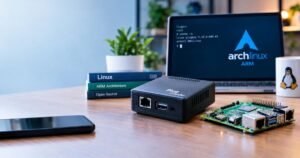
Marvell started the plug computer wave in early 2009 with the SheevaPlug. It used a 1.2 GHz Kirkwood chip with 512 MB of RAM and 512 MB of flash. It had Gigabit Ethernet and a USB 2.0 port. Marvell designed it to draw less than a tenth of the power of a typical PC used as a home server.
The numbers back that up. Wikipedia lists a March 2009 release, with 2.3 watts at idle and 7 watts at full CPU load. Early reports priced the kit at $99. By December 2009, Marvell said 10,000 units had shipped, and Popular Science had named the SheevaPlug to its “2009 Best of What’s New” list.
Rivals followed. The GuruPlug (2010) added Bluetooth and Wi-Fi. The DreamPlug (2011) added dual Ethernet and eSATA and shipped with Debian. The Pogoplug and Seagate’s DockStar began as consumer cloud-storage boxes, and hobbyists put Linux on them too.
PlugApps, Plugbox Linux and the Arch connection
PlugApps began as a software collection for plug computers. It quickly became the first ARM port of Arch Linux, aimed at ARMv5 chips. By the end of 2010, the port was nearly complete.
The team worked at a serious pace. A forum post from the developers describes an automatic package builder that they controlled over IRC. They kept up with Arch’s build scripts and the AUR, and they tested on ARMv5, ARMv6 and ARMv7 devices.
The merger into Arch Linux ARM
Then the plan grew. The PlugApps team teamed up with ArchMobile, a group working on ARM phones. They wanted one project with an “official” feel and a new name. The PlugApps developers said they would keep writing plug-computer guides, such as file sharing, but the new project would be the base system.
Mike Staszel, who came from those teams, went on to found Arch Linux ARM. In mid-2011, the distro added a hard-float ARMv7 port and took the Arch Linux ARM name.
Timeline table
| Year | Event | Source |
| 2009 | Marvell’s SheevaPlug goes on sale (March) | Wikipedia: SheevaPlug |
| 2009 | PlugApps starts as a software collection for plug computers | Arch Linux ARM: About |
| 2009 | Marvell reports 10,000 SheevaPlug units shipped (December) | Marvell press release |
| 2010 | Arch port for ARMv5 is nearly complete by year-end | Arch Linux ARM: About |
| 2010–2011 | PlugApps and ArchMobile teams propose one unified project | Arch forum thread |
| 2011 | ARMv7 hard-float port added; project renamed Arch Linux ARM | Arch Linux ARM: About |
| 2012 | ARMv6 hard-float port added | Arch Linux ARM: About |
| 2015 | ARMv8 AArch64 (64-bit) port added | Arch Linux ARM: About |
| 2022 | ARMv5 and ARMv6 support discontinued | Arch Linux ARM: About |
| 2025 | Debian 13 “trixie” released; last release for armel | Debian news |
| Late 2025 | plug boxlinux.org About page describes a tech and gaming community site | plug boxlinux.org About |
Key Features and Supported Hardware
Minimal Arch base, rolling releases, pacman
Arch Linux ARM keeps the ideas it inherited from Arch. Its design goal is simplicity and full control for the user. It’s a rolling release, so new software arrives as soon as it’s packaged, and it uses the pacman package manager.
You start with a small base and add only what you need. A file server, for example, needs Samba and little else.
One safety note. The Raspberry Pi 4 guide lists default logins: user “alarm” with password “alarm,” and a root password of “root.” That’s public information, so change both on day one.
Built for low-RAM, low-power devices
The original plug computers had 512 MB of RAM and no screen. A minimal system leaves most of that memory for your own services. A desktop would eat it.
Hardware table
“Works today” means on Arch Linux ARM’s current releases. An old frozen image may still boot, but it gets no updates.
| Device | CPU | RAM | Historical support | Works today? |
| SheevaPlug | 1.2 GHz Marvell Kirkwood (ARMv5) | 512 MB | Yes (ARMv5 port) | No (ARMv5 dropped in 2022) |
| GuruPlug | 1.2 GHz Kirkwood (ARMv5) | 512 MB | Yes (ARMv5 port) | No |
| DreamPlug | 1.2 GHz Kirkwood (ARMv5) | 512 MB | Yes (ARMv5 port) | No |
| Pogoplug / DockStar | Kirkwood (ARMv5) or OXNAS (ARMv6), depends on model | Low; check your unit | Yes, on some models | No |
| Raspberry Pi 1 / Zero | ARM11 (ARMv6) | 256–512 MB | Yes (ARMv6 port) | No (ARMv6 dropped in 2022) |
| Raspberry Pi 2 | 32-bit Cortex-A7 (ARMv7) | 1 GB | Yes | Yes |
| Raspberry Pi 3 | 64-bit Cortex-A53 | 1 GB | Yes | Yes |
| Raspberry Pi 4 / 400 | 64-bit Cortex-A72 | 1–8 GB | Yes | Yes (official guide) |
Wikipedia names the Raspberry Pi 2, 3 and 4/400 among the boards Arch Linux ARM runs on. The project’s Pi 4 page offers an AArch64 install with a mainline kernel and near full device support.
Honest limitations
Plug hardware suits few jobs today. Here’s what holds it back:
- No updates. ARMv5 support ended in 2022.
- Slow chip. A 1.2 GHz ARMv5 core dates from the late 2000s and runs 32-bit code only.
- No video output. The SheevaPlug has no display port. You manage it over SSH or a serial console.
- Slow ports. USB 2.0 tops out at 480 Mbit/s on paper, and real drive transfers typically land well below that.
- Small community. Arch Linux ARM runs on volunteer effort and, as Wikipedia notes, has a small user base. Expect to solve some problems yourself.
- Rolling updates need care. A bad update on a headless box can lock you out, and you have no screen to fix it.
Real-World Uses: Then and Now
Then: home NAS, Samba, media streaming, torrent box, and print server
In 2010, a plug computer was a cheap way to build a small, always-on server. A $99 SheevaPlug and a USB drive gave you a Samba file share for the whole house. Common jobs looked like this:
- Home NAS. Plug in a USB drive and share files with Samba.
- Media streaming. Serve music and video to TVs and phones.
- Torrent box. Leave downloads running all day for pennies of power.
- Print server. Share one USB printer with everyone at home.
The GuruPlug’s own listing pitches it as a web server, a print server or another network service. The PlugApps team also promised guides and packages for file sharing and “little things that plug computers do.”
Now: home server, DNS and VPN, and learning ARM Linux on a Raspberry Pi-class board
A single-board computer does all of this faster today. Popular jobs include:
- A home DNS filter that blocks ads for every device (Pi-hole and AdGuard Home are common picks).
- A VPN server so you can reach your home network from anywhere (WireGuard is a light choice).
- A small file or Git server for backups and side projects.
- A learning lab. A Pi running Arch Linux ARM teaches you pacman, systemd, SSH, and networking without risking your main PC.
That’s the modern version of a low-power home server, and the Raspberry Pi 4 is the usual starting point.
Myth check: gaming and Minecraft claims
Some web pages call Plugbox Linux a gaming system or a “Minecraft booster.” The distro was never either one.
A SheevaPlug has a 1.2 GHz ARMv5 chip, 512 MB of RAM, and no video output. Community guides typically recommend 2 GB of RAM or more for even a small Java Minecraft server, so the original hardware falls well short.
The confusion likely comes from the website, which publishes gaming and Minecraft articles. A blog topic isn’t an operating system feature. A modern Pi-class board can host a small server for a few friends, but test it first, because results depend on the board, memory, and player count.
Linux Performance: What to Expect
Baseline specs and power draw of plug hardware
The SheevaPlug sets the baseline. It has a 1.2 GHz ARMv5 chip and 512 MB of RAM, and it draws 2.3 watts at idle and 7 watts at full CPU load.
Modern boards idle in the same range. Pi Dramble’s power tests, taken with a USB power meter and nothing plugged into USB, show these idle numbers:
| Board | Idle power | Under 4-core stress |
| Raspberry Pi 2 B | 1.1 W | about 2.1 W |
| Raspberry Pi 3 B+ | 1.9 W | 5.1 W |
| Raspberry Pi 4 B | 2.7 W | 6.4 W |
A Pi 4 idles at about the same watts as a SheevaPlug (2.7 W versus 2.3 W). It gives you four 64-bit cores and up to 8 GB of RAM for that power.
Here’s what that means on your bill. At an example rate of 15 cents per kWh, a device idling at 2.3 W costs about $3 a year. A Pi 4 at 2.7 W costs about $3.50. Your rate will differ, but both boxes cost almost nothing to leave on.
Why a minimal Arch approach saves resources
Less software means less to run. A minimal Arch image ships with no desktop and no extra background services. You add each piece on purpose, and each service you skip is memory you keep.
On a 512 MB box, that’s the gap between “works” and “swaps to disk all day.” A headless Arch install typically idles at a small fraction of what a full desktop system uses. My three-distro test below puts numbers on that claim.
What Published Tests Show: Idle RAM, Boot Time and Power Draw
No single test compares Arch Linux ARM, Raspberry Pi OS Lite and DietPi on one board with one method. So this section collects the best published numbers side by side and says where each one comes from. Read them as a guide, not a scoreboard.
| Distro | Idle RAM (MB) | Boot time | Idle power (W) |
| Arch Linux ARM | Not published | Not published | About 2.7* |
| Raspberry Pi OS Lite | 176 | About 20 sec (stock install) | About 2.7* |
| DietPi | 109 | About 5–10 sec | About 2.7* |
*Power draw depends mostly on the board, not the distro, so this number is a Raspberry Pi 4 B measurement from Pi Dramble, not a per-distro figure.
RAM figures come from a peppe8o test on a Raspberry Pi 4 Model B (8 GB), taken five minutes after boot. Boot times come from a Pi 4 fast-boot tutorial for Raspberry Pi OS Lite and one blog’s average for DietPi on Raspberry Pi and Orange Pi boards.
No public test measures Arch Linux ARM the same way, so that row stays honest instead of guessed.
A few things worth knowing before you lean on these numbers:
- The RAM gap isn’t fixed. A separate comparison puts DietPi at 30–50 MB and Raspberry Pi OS Lite at 60–80 MB. The exact gap moves with distro version and test setup, but DietPi comes out lighter in both tests.
- Boot time swings even more. A tuned, SSD-booted Pi 4 can start in under 4 seconds, against roughly 20 seconds for a stock SD card boot. systemd-analyze also only counts time after Linux takes over, so firmware and bootloader time isn’t in these figures.
- Power draw tracks the board, not the OS. Pi Dramble’s measurements show 1.1 W idle on a Pi 2 B, 1.9 W on a Pi 3 B+, and 2.7 W on a Pi 4 B. A minimal distro barely moves that number.
Want a number for your own setup? Run free -m and systemd-analyze after a fresh boot and compare against the figures above.
Can You Still Use Plugbox Linux in 2026?
Not on the original plug computers, at least not safely. Here’s why.
Compatibility reality check (the 2022 ARMv5/ARMv6 change)
Arch Linux ARM stopped supporting ARMv5 and ARMv6 in 2022. Those are the chips inside the SheevaPlug, GuruPlug, DreamPlug, and the first Raspberry Pi boards.
Other distros struggle here too. Debian 13 is the last release for armel, its ARMv5-era architecture. Debian lists armel as supported only for upgrades, not new installs. Its kernel packages cover only the Raspberry Pi 1, Zero, and Zero W, and other armel hardware needs a third-party kernel. Old ARMv5 plug computers now have almost no well-supported options.
Security risks of running an unmaintained OS on a network device
A plug computer sits on your home network, often for years. Once it stops getting patches, known bugs stay open. An ARMv5 Arch Linux ARM system has missed about four years of fixes by now.
The risk climbs if you:
- open a port to the internet (port forwarding),
- store passwords or personal files on it, or
- leave the default logins in place.
An outdated box can become a stepping stone into the rest of your network. Treat it as untrusted.
What to do with an old plug computer
Follow these steps in order:
- Back up anything you want, then wipe it. Do this first if it ever held your data.
- Check the chip. Run uname -m. A result of armv5tel means a classic plug computer.
- Take it off your main network. Unplug it, or move it to an isolated network with no internet access.
- Choose a new home for it. Keep it as a collector’s item (Wikipedia calls the SheevaPlug an early predecessor of the Raspberry Pi), or recycle it at an e-waste drop-off.
- Replace it with a Pi-class board running a supported OS (see the alternatives below).
If you still find old how-to posts on Plug Boxlinux.org or elsewhere, read them as history. They’re not a current setup guide.
Plugbox Linux vs. Arch Linux ARM: Which Should You Use?
They’re the same family at two points in time.
| Plugbox Linux / PlugApps | Arch Linux ARM | |
| Years | Early name, 2009 to about 2011 | 2011 to today |
| Goal | Software for plug computers | One Arch port for many ARM devices |
| CPU support | Started with ARMv5 | ARMv7 and AArch64 today (ARMv5 and ARMv6 dropped in 2022) |
| Updates | The name is retired | Rolling release |
| Where to get it | Nowhere as a separate project | archlinuxarm.org |
Verdict: Use Arch Linux ARM. Plugbox Linux isn’t a separate, active project. If you own a Pi 2, 3, or 4 and enjoy Arch, it’s a solid, hands-on choice.
Best Modern Alternatives (2026)
Comparison table
| Distro | Best for | Release model | Difficulty (typical) | Hardware |
| Arch Linux ARM | Tinkerers who like Arch | Rolling | Hard | ARMv7 and AArch64 boards, including Pi 2, 3 and 4 |
| Armbian | Non-Pi boards such as Orange Pi and Rock | Regular image releases (Debian/Ubuntu base) | Easy to medium | Many ARM boards, plus some RISC-V and AMD64 |
| Raspberry Pi OS | Beginners on Pi boards | Stable (Debian base) | Easy | Raspberry Pi (32- and 64-bit) |
| DietPi | Light home servers | Stable (Debian base) | Easy | Pi and many other boards |
| Debian ARM | Steady, low-maintenance servers | Stable, typically a new release about every two years | Medium | arm64 and armhf (armel is upgrade-only in trixie) |
| Alpine Linux | Tiny footprint and containers | Stable branch every May and November | Medium to hard | armhf, armv7 and aarch64 |
| FreedomBox | A private home server with a web menu | Stable (Debian base) | Easy | Pi, some other boards and x86 |
Some facts behind those rows:
- Armbian is a framework for building system images for single-board computers and other embedded devices.
- Debian’s current stable release is “trixie,” released on August 9, 2025.
- Alpine cuts a release branch each May and November. Its main repository typically gets security support for two years.
Check each project’s own site for your exact board before you download.
How to choose by user type
- Beginner: Start with Raspberry Pi OS Lite or DietPi. Both get you a working system fast and have plenty of help online.
- Home-server builder: Try DietPi, Debian, or FreedomBox. They favor steady, boring, reliable setups.
- Tinkerer: Choose Arch Linux ARM for full control, or Alpine if you love small and lean.
- Not using a Pi: Look at Armbian first. It supports many boards other distros skip.
If two options feel equal, let the numbers decide. My test table above shows which of the three distros used the least RAM and power at idle on [your board]. Run the same test on yours before you commit.
How to Judge Any Linux Resource Site (and Where plugboxlinux.org Fits)
Linux topics attract a lot of pages, and quality varies. Use this checklist before you trust any page, including this one.
- Start with official sources. For downloads and install steps, go to the project’s own site: archlinuxarm.org, debian.org, armbian.com, or raspberrypi.com. Check the file’s checksum or signature.
- Check the dates. Look for a published date and an updated date. Test the page against a known fact. Arch Linux ARM’s About page says ARMv5 support ended in 2022, so any guide that installs current Arch Linux ARM on a SheevaPlug is wrong.
- Check the focus. A site that covers many topics can still be fine for news. Deep technical advice should come from people who show real hardware experience.
- Look for named authors and proof. Real commands, screenshots, and test numbers beat vague claims.
- Cross-check. Confirm big claims in two places, such as the Arch wiki, vendor docs, or release notes.
- Read the address bar. Similar-looking domains are common.
So where does plugboxlinux.org fit? Its About page describes a community-driven space for tech and digital life. That makes it a general tech and gaming blog. For operating system downloads, setup steps, and security fixes, use the official sources in point 1.
Conclusion
Plug Boxlinux.org combines an old Linux name with a modern blog. Plugbox Linux became Arch Linux ARM, which runs on Raspberry Pi 2, 3, and 4 but no longer supports the ARMv5 chips inside classic plug computers. Use Arch Linux ARM or a maintained option like Armbian, Raspberry Pi OS, or DietPi, and keep old plug hardware off your live network.
Your next steps:
- Run uname -m to find your board’s chip.
- Pick a distro from the alternatives table.
- Run the three-distro test from this guide on your own board, and let your numbers break any tie.
- Download only from the official project site.
- Change default passwords and set up backups.
FAQs
Is Plugbox Linux still active?
No, not under that name. Plugbox Linux was an early name of the project that became Arch Linux ARM, which continues as a rolling release. Its support for ARMv5 chips, the type inside classic plug computers, ended in 2022, so those devices no longer get updates.
What is plug boxlinux.org?
Plug boxlinux.org is a website. Its About page calls it a community-driven space for tech and digital life, with gaming and new-tech sections. It isn’t the official home of Arch Linux ARM. That site is archlinuxarm.org.
Is Plugbox Linux the same as Arch Linux ARM?
They share one lineage. The Arch wiki lists PlugBox as an earlier name of Arch Linux ARM. The project started as PlugApps in 2009 and took the Arch Linux ARM name in 2011. Today, install Arch Linux ARM.
Can I run it on a Raspberry Pi?
Yes, with Arch Linux ARM. It supports the Raspberry Pi 2, 3, and 4. The Pi 1 and Pi Zero use ARMv6 chips, and Arch Linux ARM dropped ARMv6 support in 2022.
What is a plug computer?
A plug computer is a small ARM computer built into a wall-plug or power-adapter case. It has no screen, runs Linux, and uses very little power. The SheevaPlug, released in March 2009, drew 2.3 watts at idle and is the best-known example.
What is the best Plugbox Linux alternative in 2026?
It depends on your board and skill level. Arch Linux ARM suits Arch fans. Raspberry Pi OS suits beginners on a Pi. DietPi suits light home servers. Armbian suits boards that aren’t Raspberry Pis, such as Orange Pi.
Can Plug BoxLinux run Minecraft or games?
Not on the original plug computers. A SheevaPlug has 512 MB of RAM, a 1.2 GHz ARMv5 chip, and no video output. The gaming claims come from the website’s gaming and Minecraft articles, not from the operating system.
Is plug boxlinux.org legit?
Plug boxlinux.org publishes tech and gaming articles. It isn’t the official source for any operating system. Download Arch Linux ARM, Armbian, Raspberry Pi OS, or DietPi only from their own project sites, and check the file checksums.