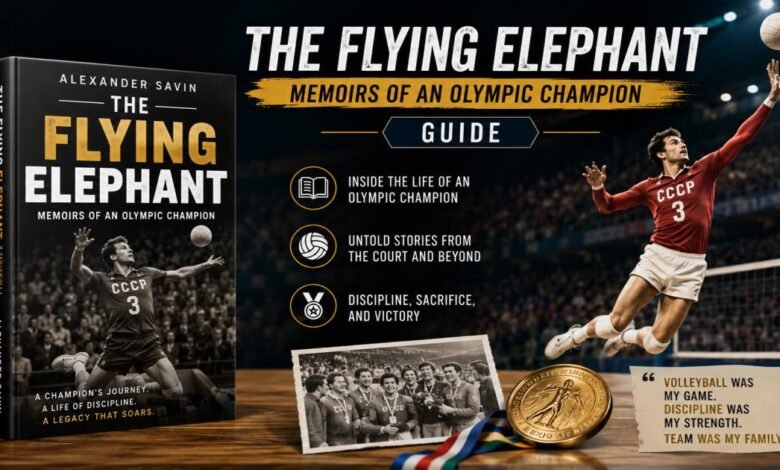
The Flying Elephant Memoirs of an Olympic Champion is the English Kindle edition of Alexander Savin’s personal story. The 1980 Olympic gold medalist and 1976 silver medalist wrote about his years as a middle blocker for CSKA Moscow and the Soviet national team. The book covers training, teammates, pressure, and life after the last match. It first appeared in Russian and reached English readers on 26 October 2025. The digital edition runs roughly 514 pages and holds more than 240 rare photographs from private and public archives.
Readers who open the book meet a tall athlete who learned the game in Obninsk, joined the army club as a teenager, and later helped the Soviet side win almost every major title between 1975 and 1985. The memoir stays close to daily reality rather than polished legend.
What Is The Flying Elephant: Memoirs of an Olympic Champion?
The Flying Elephant: Memoirs of an Olympic Champion is a sports autobiography written by Alexander Savin. He played middle blocker at 200 cm and about 97 kg. The English version was prepared by Andrei Savine, Julia Savine, Peter Murphy, and Alfredo Cabero. Peter Murphy also wrote the introduction. The large file size comes from the embedded photographs. The book is sold worldwide on Amazon Kindle.
Savin focuses on the people around him as much as on his own medals. He describes long training camps, the strict routines at CSKA, the coaches who shaped the team, and the players whose names faded from most record books. Olympic chapters sit inside a wider story of work, friendship, and the quiet costs of constant high performance. The tone is direct and personal. He records both success and the days that did not go well.
Who Is Alexander Savin?
Alexander Borisovich Savin was born on 1 July 1957 in Taganrog. His family moved to Obninsk, where he began volleyball at school. His first coach, Vladimir Pitanov, saw the potential in the tall, strong boy. By age 16, Savin was already training with the senior CSKA Moscow squad. He stayed with that club for his entire playing career and helped it claim 13 Soviet league titles.
He joined the national team in 1975 and remained until 1986. With the Soviet side he won Olympic silver in Montreal 1976 and gold in Moscow 1980. He also collected two World Championship golds (1978 and 1982), two World Cup golds (1977 and 1981), and six European Championship golds from 1975 to 1985. In 2010, the International Volleyball Hall of Fame inducted him. After he stopped playing in 1988, he coached, including time with the Madagascar national team and later work with Russian juniors.
His size and surprising jump earned him the nickname that became the book’s title. Italian writers at La Gazzetta dello Sport called him the flying elephant because a man of nearly 100 kg still rose high enough at the net to dominate as a middle blocker. Standing reach near 300 cm and a vertical jump around 92 cm made the image stick.
What Is The Flying Elephant Memoirs of an Olympic Champion About?
The memoir starts with a boy learning the sport in a provincial city and ends with a man looking back after the medals are stored away. Early chapters show the move to CSKA and the daily grind of club life. Readers see strength sessions, technical drills, and the long seasons that built the foundation for international success.
National-team sections describe the system under coaches such as Vyacheslav Platonov. Savin writes about the shared living, the pressure of representing a superpower, and the small moments of humour that kept the group together. He gives space to teammates who never became famous outside volleyball circles. Their stories sit beside the bigger victories and make the team feel real.
Olympic passages cover the 1976 final loss to Poland in five sets and the 1980 home triumph against Bulgaria. Later pages turn to the years after the national team: the shift into coaching, the search for new purpose, and the effort to keep the memory of that era alive. The book refuses to turn every setback into a neat lesson. It simply records what happened and how it felt at the time.
Why Is the Book Called “The Flying Elephant”?
The nickname came from Italian journalists who watched Savin play. They saw a heavy, powerful frame that somehow left the ground with speed and timing. The phrase captured both the physical paradox and the heavier load of expectation that elite athletes carry. Savin accepts the image without turning it into self-praise. He uses it as a simple description of how he looked on court and how the work felt from the inside.
The title also signals that the book will not stay only on the surface of medals. It points to the weight of daily discipline and the rare ability to rise above it.
Key Themes in The Flying Elephant Memoirs of an Olympic Champion
Discipline and Daily Training
Savin shows that high performance grows from ordinary hours repeated over years. CSKA and the national team demanded early mornings, technical repetition, and strength work long before modern recovery tools existed. One clear example is the steady preparation that followed the 1976 Olympic loss. The team tightened its routines and dominated the next four-year cycle. That pattern of steady work appears again and again.
Pressure at the Olympic Level
Carrying the Soviet flag meant more than personal ambition. Every major tournament sat under public expectation. Savin describes the tension of the Montreal final and the different weight of performing in front of a home crowd in Moscow. He does not dramatise the moments. He simply places the reader inside the preparation and the matches.
Teamwork and Leadership
Volleyball demands constant coordination. Savin returns often to the trust built in training camps and on long trips. Leadership, in his account, looks like quiet reliability more than loud speeches. He credits setters, outside hitters, and fellow blockers whose names rarely appear in short highlight videos. Those portraits give the team depth.
Sacrifice Behind Athletic Success
Time away from family, the physical toll on joints and muscles, and the narrow focus required for years all appear in the book. Savin records these costs without complaint or glory. He simply states what the schedule demanded and what it took from ordinary life.
Failure, Resilience, and Personal Growth
The silver medal in 1976 hurt. The team used the loss as fuel rather than a permanent scar. Later challenges, including the end of his national-team career, receive the same clear-eyed treatment. Growth comes from clearer work after the setback, not from slogans.
Life and Identity After Sport
One of the most useful parts of the memoir looks at the years after the last major tournament. The daily structure of elite sport disappears. Savin describes the move into coaching and the slower process of finding purpose outside the court. That section speaks to any athlete who has faced the same transition.
Alexander Savin’s Olympic Journey
At the 1976 Montreal Games, the 19-year-old Savin played every match. The Soviets swept their pool and won the semifinal, then lost the gold-medal match to Poland 3-2. The defeat stayed with the team.
Four years later in Moscow, the same group returned better prepared. Savin again played every match. The Soviets controlled their pool, swept Romania in the semifinal, and beat Bulgaria 3-1 in the final. Gold on home soil closed the circle that had opened with silver abroad. For Savin the two Olympics marked both the peak of his playing years and a public answer to the earlier loss.
What Makes This Olympic Memoir Different?
Most athlete books lean on medal counts and statistics. The Flying Elephant Memoirs of an Olympic Champion spends more pages on people than on podiums. Savin writes about teammates who never became household names, about coaches whose methods shaped a generation, and about the everyday reality of Soviet sports culture. The 240-plus photographs turn the text into a visual record. Many of those images had stayed in private collections until the English edition. That mix of personal memory and historical detail sets the book apart.

The Flying Elephant Kindle Edition: What to Know
The English edition is digital only. Publication date is 26 October 2025. Length is listed at 514 pages. File size reaches about 68.8 MB because of the photographs. Translators and editors are Andrei Savine, Julia Savine, Peter Murphy, and Alfredo Cabero. The book works best on a tablet or larger screen so the images display clearly. It is available on Amazon Kindle worldwide and appears in Kindle Unlimited in many regions.
Who Should Read The Flying Elephant: Memoirs of an Olympic Champion?
Volleyball fans who want the inside view of the Soviet golden era will find the detail rewarding. Athletes and coaches looking for honest talk about training, pressure, and team life will recognise the patterns. Readers of Olympic history and Soviet-era sport will gain a primary source. Fans of athlete autobiographies that refuse to polish every story into legend will stay engaged. Anyone curious about the human side of high-level competition will find material that travels beyond the court.
What Can Readers Learn From Alexander Savin’s Memoir?
Long-term discipline grows from daily repetition rather than sudden bursts of motivation. Pressure at the highest level is managed through preparation and trust in teammates. Setbacks become useful only when they produce clearer work afterward. Success at the Olympic level extracts a personal cost that medal lists never show. Identity after sport is something every athlete must build deliberately. These points appear through concrete scenes rather than abstract advice.
Is The Flying Elephant Memoirs of an Olympic Champion Worth Reading?
The strengths are clear: an authentic voice, generous attention to teammates, a rich photographic archive, a grounded view of Soviet sports culture, and honest reflection on the years after competition. The book is long and detailed. Readers who want only short medal stories or modern training science may find the pace slower than expected. Some cultural references need a moment of context for readers new to the era. The best fit remains people who want the human story behind one of volleyball’s most successful teams and an Olympic champion’s unfiltered account. The memoir earns its place by preserving a chapter of sports history that risked fading and by offering practical insight into what elite performance actually costs and returns.
Final Verdict
The Flying Elephant Memoirs of an Olympic Champion succeeds because it refuses to turn its author into a cartoon hero. Alexander Savin records the work, the friendships, the pressure, the failures, and the quiet years that followed. For volleyball fans, sports-history readers, and anyone who values firsthand testimony over polished legend, the book stands as a clear recommendation. The unusual title fits: a big, grounded athlete who stayed airborne long enough to leave a lasting mark.
Frequently Asked Questions
Who wrote The Flying Elephant: Memoirs of an Olympic Champion?
Alexander Savin, the Soviet middle blocker who won Olympic silver in 1976 and gold in 1980. The English edition was prepared by Andrei Savine, Julia Savine, Peter Murphy, and Alfredo Cabero.
Is Alexander Savin an Olympic champion?
Yes. He won gold with the Soviet Union at the 1980 Moscow Olympics and silver at the 1976 Montreal Olympics.
What sport did Alexander Savin play?
Men’s volleyball. He competed as a middle blocker for CSKA Moscow and the Soviet national team.
What is The Flying Elephant about?
It is Savin’s personal account of his athletic career, the Soviet volleyball system, Olympic competition, teammates, and life after elite sport, illustrated with more than 240 rare photographs.
Is The Flying Elephant available as a Kindle edition?
Yes. The English Kindle edition was published on 26 October 2025 and is available on Amazon worldwide.
Why is the book called The Flying Elephant?
Italian journalists nicknamed Savin “the flying elephant” because of his large frame combined with exceptional jumping ability and net presence.
Who should read this Olympic memoir?
Volleyball enthusiasts, athletes and coaches, Olympic-history readers, and anyone interested in honest athlete autobiographies or Soviet-era sports culture.