Picture a release calendar with a new feature going out every Thursday. Now picture the test suite meant to cover it, still running the same checks it ran six months ago, because nobody had time to write new ones. This is not a hypothetical. It is the default state for most fast-moving product teams. AI agents for QA were built specifically to solve this problem. Think of it as a system that watches your application, generates its own tests, conducts them, and fixes any issues, mostly without human intervention, instead of a tool you run manually.
Breaking Down What One of These Agents Actually Does
An AI testing agent is software that handles the testing workflow on its own. It studies your app, generates test cases from plain language requirements, executes them, and updates scripts when something in the UI shifts. It is less a tool and more a teammate that never gets tired of repetitive checks.
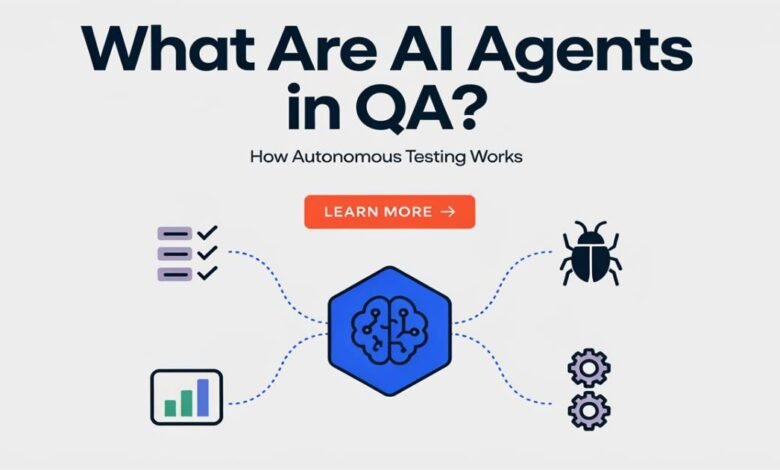
Underneath, there are usually four parts working together. One watches the current state of your app. Another remembers past runs and known bugs. A third decides what needs testing next based on risk. The last one actually executes everything and logs what happens.
Sorting the Work These Agents Actually Handle
It helps to think in terms of tasks rather than technical labels.
Some agents focus purely on writing tests, turning a user story or a design file into actual test steps without anyone scripting a thing. Others specialize in maintenance, catching broken selectors and UI shifts before they cause a wave of false failures.
There are agents dedicated to coverage, mapping your app against what has actually been tested and pointing out the gaps nobody noticed. Others handle prioritization, deciding which tests matter most so your pipeline is not wasting hours running everything blindly.
A few focus on failure analysis, sorting real bugs from flaky noise. Some generate realistic test data instead of the same three sample inputs reused everywhere. And some simply package up bug reports, screenshots, logs, and steps included so they land in your tracker ready to act on.
What Actually Convinces Teams to Adopt This?
The appeal is not really about automation for its own sake. It is about getting hours back. The coding barrier is overcome when test cases are written in basic English, enabling non-engineers to make substantial contributions to test coverage.
Self-healing is probably the biggest relief for most teams. When AI agents for software testing catch a UI change and quietly update the affected script, tests stop failing for the wrong reasons. Nobody has to spend a Friday afternoon chasing down why a passing feature suddenly shows red.
There is also the coverage angle. These agents tend to notice under tested paths that human testers overlook simply because there is too much surface area to track manually.
Where the Rollout Gets Genuinely Difficult
None of this works well if the underlying test data is a mess. Agents learn from what already exists, so sparse or inconsistent data leads to sparse or inconsistent test generation. Cleaning that up first genuinely matters.
Connecting these systems into older pipelines also takes real effort. It rarely works the moment you plug it in, and teams should expect a few weeks of setup before things run smoothly.
Where Testing Heads From Here
The next stage resembles a small collection of specialized agents sharing their expertise with one another rather than a single agent. Additionally, exploratory testing will definitely become more sophisticated, with bots driving testers toward the most risky locations rather than relying purely on intuition.
In the future, test cases may be built based on real user behavior rather than presumptions about how a feature ought to be employed. That shift alone would change what quality assurance even means day to day.