A small business owner agrees to cybersecurity training, the staff sit through a forty-minute video, and three weeks later someone wires money to a fraudster who impersonated the owner. The training happened. It simply did not stick. For MSPs that sell or bundle awareness programs, this pattern is familiar and costly, because a client breached after “completing” training starts to question the value of the whole service.
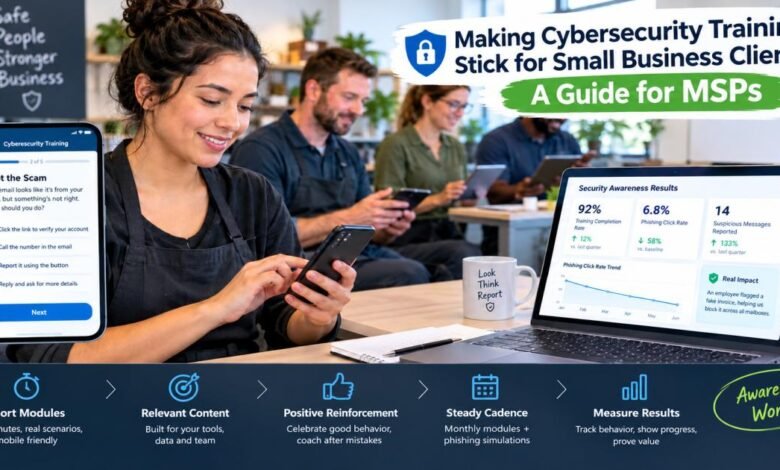
Retention is a design problem, not a motivation problem. Small business staff juggle customers, phones, and deadlines, and security is rarely their job title. Programs that respect that reality tend to share five traits: short modules, relevance to the specific business, positive reinforcement, a steady cadence, and proof of results. The sections below take each in turn, with practical steps an MSP can fold into existing client services.
Short Modules Fit the Workday, Not the Calendar
Long sessions fight against how people learn. Attention drops, and a single annual course packs in so much that employees remember a slogan or two. Modules of three to five minutes, each covering one behavior, slot between phone calls and are far easier to retain. One module might cover spotting a spoofed sender address. Another might cover confirming a bank detail change by phone.
Single-topic modules also let the MSP react to events. When a wave of fake shipping notices hits a client’s industry, a two-minute refresher on delivery scams can go out within days instead of waiting for the next scheduled course. Staff see a direct link between the lesson and something that just landed in their inbox, which strengthens recall.
Format deserves some thought. Modules that work on a phone suit employees who spend their days in a shop, warehouse, or clinic rather than at a desk. Captions, plain language, and quick knowledge checks make content accessible to a mixed workforce. Interactivity helps, but not at the cost of length: a short scenario where the employee chooses what to do next teaches more than a passive video of the same duration. Completion deadlines should be generous, since a two-week window respects busy seasons.
Making Content Relevant to Each Business
Generic content earns generic attention. A dental office faces different threats from a landscaping company or an accounting firm, and staff notice when examples do not match their work. Relevance turns training from an obligation into useful information.
Before assigning content, an MSP can gather a few facts about each client:
- The main tools staff use daily, such as the email platform, payroll system, or practice software
- The kinds of sensitive data handled, such as patient records, payment details, or client tax files
- Who authorizes payments or changes to bank details
- The outside parties employees most often hear from
- Any regulatory duties, such as HIPAA or payment card rules
With those answers, examples can be adjusted. An accounting firm sees a fake client request to change refund bank details around filing season. A dental office sees a message that resembles a records request from an insurer. Roles matter inside the business as well, since reception staff, bookkeepers, and owners each receive different lures, and short extra modules for the highest-risk roles earn their place. Tone counts too. Phrases about “threat actors” land poorly with a five-person team, whereas a plain description of what a scam looks like in their own inbox will be remembered.
Positive Reinforcement Beats Fear
Fear-based training produces avoidance. Employees who expect blame learn to hide mistakes, and a hidden click is the most expensive kind. Positive reinforcement works in the opposite direction by making good behavior visible and rewarded.
Reporting a suspicious email should earn an immediate acknowledgment, even when the message turns out to be harmless. An automatic thank-you, a quick note from the service desk, or a brief mention in a team meeting all tell staff that speaking up is valued. Some clients add light recognition, such as a monthly shout-out for the person who flagged the most real threats, without turning it into a contest that pressures anyone.
When someone clicks a simulated lure, the response should be a short lesson at that moment, not a reprimand. The page can show the clues that were present and describe the next step to take. Owners help by sharing their own near misses in staff meetings, which signals that falling for a scam is common, not shameful. Over months, the culture shifts from “avoid getting caught” to “help us catch it,” and that shift is what stops real attacks early.
Small rituals help sustain the mood. A short weekly tip in the staff chat, a printed reminder near the front desk about the reporting button, or a quick mention at the Monday meeting keeps the habit present. None of these takes more than a minute, yet together they show that the subject matters to the people running the business.
Setting a Cadence and Choosing the Platform Behind It
Memory fades without repetition, so cadence matters as much as content. A schedule that mixes a short module every month or two with a simulated phishing message at irregular intervals keeps the subject present without overwhelming staff. New hires deserve their own track, because the first weeks are when habits form and when attackers are most likely to impersonate a manager to someone who does not yet know the real one.
Managing this across dozens of small clients by hand is unrealistic, which is why tooling matters. Platforms built for MSPs, such as Phin security awareness training, typically let a provider run campaigns for many client organizations from one place, with separate settings and reporting for each. Whatever the choice, a few practical checks apply: automated enrollment when staff join or leave, scheduling that spreads campaigns out, and the ability to adjust content per client without rebuilding everything.
Automation should not replace judgment. A technician or account manager still needs to review the calendar, decide when a client’s busy season makes a campaign unwise, and add timely content when a real scam circulates. Teams using Phin security awareness training or a comparable service get the most from it when the schedule is treated as a living plan rather than a set-and-forget task.
Proving Results to Clients
Clients renew what they can see working. Reporting should therefore translate activity into outcomes an owner understands. Completion rates show participation but not behavior. Better signals include the share of employees who report simulated phishing, the trend in click rates against a baseline set before training began, and the number of real suspicious messages staff flagged to the MSP.
Stories supplement numbers. A short note that an employee flagged a fake invoice and helped the MSP block it across every mailbox illustrates value in a way a percentage cannot. Reports should stay honest: a month with higher click rates after a harder template is a useful finding, not a failure, and explaining it builds credibility.
Format matters too. A one-page summary for the owner, with a clear trend line and two recommendations, beats a long export. Quarterly business reviews are the natural setting, and the MSP can tie results to related work, such as email filtering changes made after a repeated lure. Comparing a client with its own past performance, not with other clients, keeps the conversation constructive. Tracking the time between a message arriving and the first report is also revealing, since fast reporting limits harm.
Benchmarks add perspective for owners who ask how they compare. Aggregated, anonymized results from the MSP’s wider client base can show whether a small business is ahead of or behind similar firms, provided the data is presented carefully and never exposes another client’s information.
Final Analysis
Training sticks when it is short, relevant, encouraging, repeated, and measured. None of these ideas requires exotic tools. They require attention to how small teams actually work. An MSP that tailors examples to each client’s tools and data, thanks people for reporting, and shows a trend on paper will see better behavior and a stronger renewal conversation.
Starting with one or two clients is a practical way to refine the approach. Collect feedback on module length, note which examples resonated, and adjust before rolling the method across the full client base. Over time, a steady cadence and visible results turn training from a yearly chore into a habit that protects the business.
One more habit pays off over time: keep a short log of what changed after each review, whether a new module, a different template, or an adjusted schedule. That record shows the client, and the MSP’s own team, which adjustments moved the numbers.