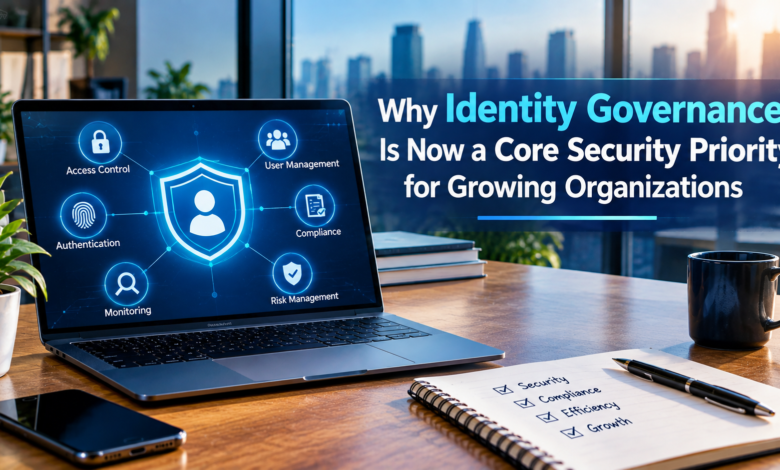
Identity has become one of the most important control points in modern security. Employees, contractors, applications, service accounts, bots, and AI agents can all receive access to business systems. As organizations grow, the number of identities and permissions can increase faster than security teams can manually review them.
The result is an expanding attack surface. An account may retain access after a person changes roles, a service account may accumulate permissions over time, or an automated identity may receive access that nobody regularly reviews.
Identity governance addresses this problem by helping organizations understand who or what has access, why that access exists, and whether it remains appropriate.
Identity Has Become a Major Attack Surface
A compromised identity can provide an attacker with legitimate-looking access. Instead of breaking through a technical barrier, an attacker may attempt to use stolen credentials, excessive privileges, compromised service accounts, or other authorized pathways.
The risk becomes harder to manage as companies adopt more cloud applications and distributed infrastructure. Each system can introduce its own users, groups, roles, and permissions.
Security leaders therefore need visibility across the identity environment rather than isolated information from individual applications.
The problem is particularly difficult when access is granted through layers of groups and inherited permissions. An employee may appear to have a simple role while actually receiving access to many resources through several connected relationships.
Access Sprawl Creates Hidden Risk
Access sprawl occurs when users accumulate permissions that are no longer necessary. A person changes departments but keeps old access. A contractor finishes a project but remains active. A service account receives additional permissions during troubleshooting and never loses them.
These situations create security risk because excessive access gives compromised identities more opportunities to reach sensitive systems.
Regular access reviews can help, but traditional reviews often rely heavily on spreadsheets, disconnected application data, and manual decisions. Security teams may spend considerable time gathering information before they can even determine whether a permission is appropriate.
Modern identity governance focuses on creating a clearer picture of identities, entitlements, and relationships so decisions can be made using better context.
Compliance Adds Another Layer of Pressure
Organizations in regulated industries often need to demonstrate that access is reviewed and controlled. Auditors may ask who has access to sensitive systems, how permissions are approved, and whether former employees are removed promptly.
Compliance requirements therefore make identity governance an operational issue as well as a security issue.
A useful governance program should be able to show how access decisions are made and provide evidence that controls operate consistently. Manual spreadsheets may work temporarily for a small environment, but they become harder to maintain as the organization grows.
Growing companies need processes that can keep pace with changing employees, applications, permissions, and organizational structures.
Non-Human Identities Are Changing the Problem
Human users are only one part of the identity environment. Service accounts, API credentials, automation tools, bots, and AI agents can also interact with business systems.
These non-human identities can be difficult to manage because they may not follow ordinary employee lifecycle processes. A service account does not resign from a company, for example. It may continue operating for years while accumulating access to additional resources.
Modern identity governance needs to account for these identities alongside human users. A governance approach that ignores machine identities leaves a significant part of the access environment outside regular review.
Choosing a Governance Platform
Organizations evaluating an identity governance platform should look for visibility across identity types, automated workflows, access reviews, lifecycle management, integrations, and policy enforcement.
The platform should help security teams understand relationships between identities and permissions rather than simply presenting disconnected lists.
Linx describes its modern identity governance platform as covering human, non-human, and AI-agent identities through a unified identity graph, with automated workflows and continuous policy enforcement.
The category should be evaluated according to the organization’s actual environment. A platform that works well in one cloud-heavy company may require different integrations or processes in another.
Governance Needs to Become Continuous
Periodic reviews alone can miss changes that occur between review cycles. Employees move, applications change, new accounts appear, and permissions evolve continuously.
Continuous governance aims to identify those changes closer to when they occur. Automated workflows can flag excessive access, support remediation, and keep governance information more current.
That does not mean humans disappear from the process. Security teams still need to define policies, investigate unusual situations, and make decisions where context matters.
Automation simply allows teams to spend less time collecting basic information and more time evaluating actual risk.
Building a Stronger Identity Security Program
Identity governance is increasingly tied to the broader security strategy because identity connects people and systems to the resources they use.
A growing organization should understand its identity inventory, monitor access changes, review excessive permissions, govern non-human identities, and maintain evidence for compliance requirements.
The goal is not to create more administrative work. It is to establish a repeatable way to keep access aligned with business responsibilities.
As organizations continue adopting cloud services, automation, and AI, identity governance will become increasingly important for maintaining control over who and what can reach critical systems.