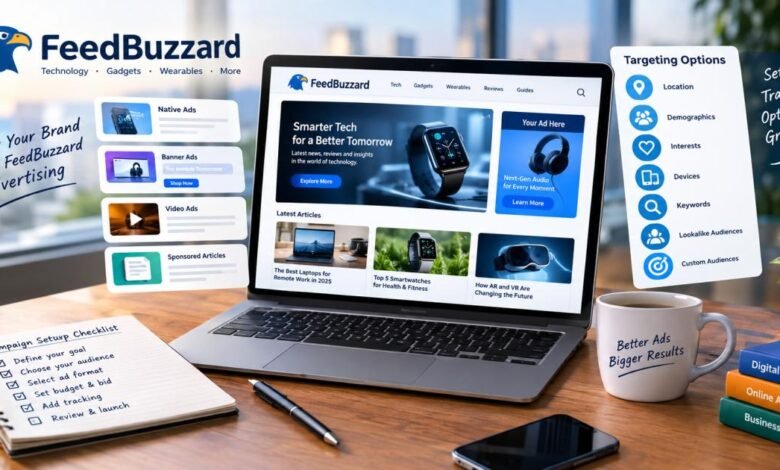
Advertising FeedBuzzard means paying to promote your brand on FeedBuzzard.com, a technology-focused content site. You do this by contacting the site directly, not through a self-serve dashboard. The site’s advertising page shows no pricing, no ad specs, and no traffic figures. It sends you to a contact route instead.
That one fact shapes this whole guide.
Search “advertising feedbuzzard,” and you will find dozens of articles. Many describe a full ad platform with bid tools and live dashboards—few show proof. So advertisers keep asking the same questions. What does it offer? What does it cost? Is it safe to pay?
This guide covers how FeedBuzzard advertising seems to work, the ad formats people mention, pricing claims, a nine-step setup plan, and ways to measure results. It also shows you how to verify the claims before you spend anything.
How we sorted the facts. We compared FeedBuzzard’s own advertising page with more than ten third-party guides. Facts from the site are marked as such. Claims from other sites are labeled “third-party” and should be treated as leads, not facts.
Quick Answers
| Question | Short answer |
| What is advertising FeedBuzzard? | Paid promotion on FeedBuzzard.com, a tech-focused content site |
| How do you start? | Contact the site through its advertising or contact page |
| What does it cost? | No verified public price; quotes come from the publisher |
| What formats are claimed? | Native cards, banners, sponsored articles, video, newsletter slots |
| Can you trust the claims? | Verify first; most details come from third parties |
What Is FeedBuzzard Advertising?
FeedBuzzard advertising is the set of paid promotion options linked to FeedBuzzard.com. One review describes the site as a content publisher, not a programmatic ad platform. That means you buy space from a publisher. You do not bid in an open auction.
Think of the difference like this. Google Ads is a huge marketplace. You log in, set a budget, and ads run within minutes. A publisher deal works more like renting a booth at a local fair. You talk to the organizer, agree on a spot and a price, and hand over your sign.
Sources also disagree about what FeedBuzzard is. Some call it a content aggregator that pulls news and trending stories into one feed, while others call it an ad platform. Another describes it as a content-publishing and advertising platform covering tech, business, and lifestyle topics.
You can say three things with fair confidence:
- FeedBuzzard.com exists and publishes content.
- It has an advertising page.
- That page lists no rates, specs, or traffic data.
Everything else needs a direct answer from the site.
How Does Advertising FeedBuzzard Work?
Most credible descriptions point to a direct-buy model. One guide tells advertisers to find the advertising or contact page, send a short inquiry about their brand and goals, and request formats, traffic data, and pricing before agreeing to anything.
A typical flow looks like this:
- You send an inquiry. Share your brand, goal, and budget range.
- The publisher replies. You get formats, rates, and ideally a media kit.
- You agree on terms. This covers placement, dates, and price.
- You send your creative. That means images, copy, or a full article.
- The ad runs. You track clicks and sales in your own analytics.
Some third-party pages describe something fancier. One says FeedBuzzard uses data and search tools to show ads at the best time for specific groups. Another says it offers AI-powered content creation and real-time audience discovery. We could not confirm either claim on the site. If those tools exist, FeedBuzzard should be able to show you a demo.
FeedBuzzard Ad Formats
Third-party sources say FeedBuzzard describes four formats: native cards, banners, video ads, and sponsored articles. Another source adds newsletter placements but notes they only work if the site keeps an active subscriber list.
Here is a plain look at each one. Confirm every format with the site, because availability can vary.
Native Ads
Native ads match the look of the content around them. On a feed site, that means a card that sits between articles and reads like part of the page.
They often earn more attention than banners because they do not look like ads. One article cites a 2026 report saying 68% of consumers ignore standard display ads. That figure is a third-party summary, so treat it with care. The idea is sound, though. People skip what looks like an ad.
Label native ads clearly. An honest headline builds more trust than a clever trick.
Banner and Display Ads
Banners are image ads placed at the top, side, or bottom of a page. One guide says they sit in the top, sidebar, or footer areas of article pages.
They suit brand awareness. They are easy to make and easy to test. Their weakness is banner blindness. Readers learn to look past them.
If you try banners, ask which pages carry the ad. A banner on a popular article is worth far more than one on a page nobody visits.
Video Ads
Some sources list video spots among the formats. Others warn that these claims often come with specific rate figures that do not appear on FeedBuzzard’s own advertising page.
If video matters to your plan, ask for proof. Request a live example. Ask about file size, length limits, and mobile playback.
Sponsored Articles
A sponsored article is a full post written by you or for you, published on the site and marked as sponsored. It can tell a longer story than any banner can.
Some marketers like this format for the backlink it can carry. One report says third-party resellers sell FeedBuzzard as a guest-post and backlink product, with listings near $179 and a Domain Authority around 56. Those are reseller claims, not an official offer. Also, search engines typically ask paid links to carry a “sponsored” tag, so a paid link may pass little ranking value.
Other Advertising Placements
A few more options come up in third-party lists:
- Newsletter slots. An ad inside an email update. Ask for the subscriber count and open rate.
- Featured listings. One guide lists these next to banners and sponsored articles.
- Homepage placements. A fixed spot on the main page, often sold by the month.
FeedBuzzard Targeting Options
Targeting means choosing who sees your ad. Some articles say FeedBuzzard offers interest-based, behavioral, and demographic targeting. That list is standard for big ad systems. It would be unusual for a small publisher.
On a publisher site, the most realistic option is targeting by topic and placement. Your ad sits beside tech content, so it reaches people who read tech content. That is context targeting. It works well when your product fits the page.
Ask these questions before you pay:
- Can I pick specific categories or pages?
- Can I limit the ad by country or city?
- Can I choose mobile, desktop, or both?
- Does the site use any user-level data, and how does it collect it?
A “no” to most of these is fine. You just need to know. A gadget brand can still do well on a tech site with simple placement.
How Much Does FeedBuzzard Advertising Cost?
Nobody outside FeedBuzzard can give you a verified price. The advertising page lists no rates. One guide says pricing is negotiated per campaign and typically follows other niche tech publisher rates.

Third-party numbers vary a lot:
| Claim | Source type | Treat as |
| CPM near $4.20 | Third-party article | Unverified |
| 50–300 per placement | Estimate based on similar sites | Rough guess |
| Guest post or banner link near $179 | Reseller listing | Unverified |
| CPC, CPM, and CPI models | Third-party description | Unverified |
The $4.20 CPM claim says costs run nearly half of standard platforms. The 50–300 range is what comparable mid-authority sites typically charge, depending on format and link inclusion. Neither number comes from FeedBuzzard.
Price may depend on the format, placement, campaign length, expected reach, and whether content creation is included.
Pricing terms in short:
- CPM means cost per 1,000 views.
- CPC means cost per click.
- CPI means cost per install, mostly used for apps.
- Flat fee means one set price for a time period.
Flat fees are common on small publisher sites. They are simple, but you pay whether or not anyone clicks.
FeedBuzzard Advertising Pricing: What Should You Verify Before Paying?
Never pay on a number you saw on a blog. Get these answers in writing:
- Exact price and scope. Dates, placement, and any extras.
- Traffic data. Monthly visits, top countries, and device split.
- Audience details. Who reads the site, and what they read.
- Ad specs. Sizes, file types, and word limits.
- Link rules. Will the link carry a “sponsored” or “nofollow” tag?
- Reporting. What stats you get, and how often.
- Refund and cancellation terms. What happens if the ad never runs.
A proper media kit should include traffic numbers, audience demographics, ad specs, pricing tiers, and terms. If the site cannot provide one on request, treat that as a yellow flag.
Pay by card when you can. A card usually gives more protection than a bank transfer or crypto.
How to Set Up an Advertising FeedBuzzard Campaign
No self-serve tool has been confirmed. So this plan is built for a direct deal. It also works with any small publisher.
1. Define Your Campaign Goal
Pick one goal: visits, sign-ups, sales, or brand awareness. A clear goal tells you what to measure.
Write it as a number. “Get 50 free-trial sign-ups in 30 days” beats “get more users.”
2. Identify Your Target Audience
Describe your ideal customer in a few lines. Include age range, interests, job type, and country.
Then ask whether FeedBuzzard’s readers match. If you sell tax software for farmers, a gadget site may not fit.
3. Choose the Right Ad Format
Match the format to your goal:
| Goal | Format to consider |
| Brand awareness | Banner |
| Clicks and visits | Native card |
| Trust and education | Sponsored article |
| Direct reach | Newsletter slot |
Start with one format. Mixing three at once hides what worked.
4. Prepare Your Creative Assets
Get your files ready before you reach out. Common standard banner sizes include 300×250, 728×90, and 160×600. Ask FeedBuzzard which ones it accepts.
For native or sponsored content, write a clear headline, a short description, and one call to action. Add a clean image. Make sure your landing page loads fast on a phone.
5. Set Your Budget and Bid
Decide the most you will spend. Keep it small for a first test, because a small test teaches more than a big gamble.
If the site offers CPM or CPC, set your top rate. If it offers a flat fee, ask for a short run, such as two to four weeks, before you commit to more.
6. Configure Conversion Tracking
This step matters most. Without tracking, you cannot tell if the ad paid off.
- Add UTM tags so your analytics shows the source.
- Set up a goal or event for sign-ups or sales.
- Use a dedicated landing page or a unique coupon code.
A UTM link looks like this: yoursite.com/offer?utm_source=feedbuzzard&utm_medium=native&utm_campaign=test1
7. Submit and Review the Campaign
Send your files and terms. Ask the site to confirm the live date, placement, and link in writing.
Check that the ad is labeled as paid. Clear labels protect you and the reader. If the site offers a preview, approve it before launch.
8. Monitor Initial Performance
Check the ad on day one. Make sure it appears, looks right, and the link works.
Then check your analytics every few days. Watch clicks, bounce rate, and sign-ups. Early numbers are noisy, so avoid big changes in week one.
9. Optimize and Scale
After a few weeks, compare results with your goal. If the ad works, extend the run or add a second format. If it does not, change one thing at a time: the headline, the image, or the landing page.
Scale slowly. Double the budget only after the numbers hold for a full cycle.
How to Create Effective FeedBuzzard Ads
Good ads on a content site follow the rules of good writing. Be clear, be useful, and be brief.
- Lead with the reader’s problem. “Tired of slow laptops?” beats “Introducing our new brand.”
- Use plain words. Skip jargon and big claims.
- Show one offer. One ad, one action.
- Match the page. On a tech site, sound like a helpful tech writer.
- Use a real image. A clear product photo typically beats stock art.
- Keep the promise. Your landing page must match the ad.
- Label it. Readers trust brands that are open about paid content.
When you can, test two headlines against each other. Small changes often move results more than you expect.
How to Measure FeedBuzzard Advertising Performance
Track a handful of numbers:
| Metric | What it tells you | How to figure it |
| Impressions | How often the ad was seen | Ask the site |
| CTR (click-through rate) | How many viewers clicked | Clicks ÷ impressions |
| CPC (cost per click) | What each visit costs | Spend ÷ clicks |
| Conversion rate | How many visits became actions | Actions ÷ clicks |
| CPA (cost per action) | What each sale or sign-up costs | Spend ÷ actions |
| ROAS | Revenue per ad dollar | Revenue ÷ spend |
Here is a made-up example. It is not a FeedBuzzard result.
You pay a flat $200. The ad gets 20,000 views and a 0.3% click rate. That is 60 clicks, so each click costs about $3.33. If 3 of those clicks buy a $100 product, you earn $300 on $200. Your ROAS is 1.5.
Trust your own analytics first. Because the site publishes no traffic figures, any report it sends should be checked against your own data.
FeedBuzzard Advertising: Pros and Cons
Potential Advantages
- Tech-focused audience. Good for software, gadgets, and online tools.
- Possible low entry cost. Small publishers often have flexible budgets.
- Less competition. Fewer advertisers may mean less noise.
- Direct contact. You talk to a real person and can negotiate.
- Content options. Sponsored articles tell a fuller story.
Potential Limitations
- No public prices or specs. You must ask for everything.
- Unverified traffic. No independent third-party source confirms that FeedBuzzard runs as a working ad platform with real advertisers and traffic.
- Mixed messages online. Many articles contradict each other.
- Limited reporting. Small sites may not offer detailed stats.
- Lookalike sites. Several similarly named sites exist. Make sure you reach the right one.
- Narrow reach. A niche site cannot match Google or Meta for scale.
Is Advertising FeedBuzzard Worth It?
It might be, for the right advertiser and with the right checks. It is a low-risk test only if you keep the first spend small and ask for proof.
It fits you if you sell tech-related products, want a niche audience, and are happy to negotiate directly.
It is a poor fit if you need fast, large-scale reach, self-serve controls, or detailed live reports on day one.
The honest answer is “it depends on what they show you.” If FeedBuzzard shares real traffic data and a clear media kit, a small test makes sense. If it cannot, spend your money elsewhere.
FeedBuzzard vs. Google Ads, Meta Ads & Other Ad Platforms
Here is how a direct publisher deal compares with the big platforms:
| Factor | FeedBuzzard (direct buy) | Google Ads | Meta Ads | Native networks (Taboola, Outbrain) |
| Setup | Contact the site | Self-serve | Self-serve | Mostly self-serve |
| Pricing | Negotiated, unpublished | Auction | Auction | Auction or set rates |
| Reach | Small, niche | Very large | Very large | Large, across many sites |
| Targeting | Likely topic-based | Keywords, location, audience | Interests, behavior, lookalikes | Context and audience |
| Reporting | Unclear | Detailed | Detailed | Detailed |
| Best for | Niche tests, sponsored posts | Search intent | Social reach | Content promotion |
With a network, you typically get published rate cards or self-serve bidding. With a direct deal, you get your price through contact.
The big platforms win on tools and scale. A small publisher can win on fit and cost, but only when the audience matches your buyer.
How to Verify FeedBuzzard Before Spending Your Advertising Budget
Run these checks in order. Each takes a few minutes.
- Confirm the domain. Type feedbuzzard.com yourself. Do not click a link from an email or ad.
- Use official contact details only. One guide advises using only the contact form or email listed on the site.
- Ask for a media kit. Look for traffic, audience, specs, and terms.
- Check traffic with a third-party tool. Compare their numbers with a public estimate. Small gaps are normal. Huge gaps are not.
- Review the site itself. Is the content fresh? Does it have a real About page, named authors, and a working contact page?
- Ask for past advertisers. Request two references or live example ads.
- Read the terms in writing. Know what happens if the ad does not run.
- Start small. Pay for a short test before any long deal.
- Never pay in full up front for a long run without proof of delivery.
Be wary if anyone rushes you to pay, refuses to share basics, or only accepts crypto or wire transfers.
Final Verdict
Maybe, with care.
What is clear is small. FeedBuzzard.com is a real site with an advertising page that leads to direct contact. What is unclear is large. Prices, traffic, audience, and ad tools are not shown, and most online claims come from third parties without proof.
If you sell something tech-related and like negotiating directly, a small test could work. Ask for a media kit. Check the traffic yourself. Track every click with your own tools. Spend a little first, and scale only when the numbers earn it.
If the site cannot answer basic questions, walk away. Your budget works harder on a platform that shows you its data.
FAQs
What is advertising FeedBuzzard?
Advertising FeedBuzzard is paid promotion on FeedBuzzard.com, a technology-focused content site. It appears to be sold through direct contact, using placements like banners, native cards, and sponsored articles. Details vary across sources, so confirm them with the site.
How do I advertise on FeedBuzzard?
Visit feedbuzzard.com and find the advertise or contact page. Send a short note with your brand, goal, and budget range. Ask for formats, traffic data, pricing, and terms. Agree on everything in writing before you pay.
What ad formats does FeedBuzzard offer?
Third-party sources mention banner ads, native feed ads, sponsored articles, video spots, and newsletter slots. The site’s own advertising page does not list formats. Ask which ones are live today.
How much does FeedBuzzard advertising cost?
There is no verified public price. Third-party estimates run from about $50 to $300 per placement, and one article cites a CPM near $4.20. Treat all of these as unconfirmed and request a written quote.
Does FeedBuzzard support CPC or CPM advertising?
Some third-party pages say it supports CPC, CPM, and CPI models. The site does not confirm this publicly. Flat-fee deals are also common on small publisher sites, so ask which model applies to you.
Can I target users by location?
It is not confirmed. Some sources claim interest, behavior, and demographic targeting, but the site does not publish these options. Ask whether you can limit ads by country, device, or topic.
Is FeedBuzzard suitable for small businesses?
It can be, especially for tech-related brands that want a niche audience on a small budget. Keep your first test short and cheap, and get traffic data before you commit.
How can I track FeedBuzzard campaign results?
Use your own tools. Add UTM tags to your links, set up goals in your analytics, and use a unique landing page or coupon code. Compare those numbers with any report the site sends.
Is FeedBuzzard advertising legitimate?
The site exists and has an advertising page. Beyond that, no independent source confirms its traffic or ad results. That is not proof of a problem, but it means you should verify before paying.
What should I verify before launching a campaign?
Verify the domain, contact details, traffic and audience data, ad specs, link rules, reporting, and refund terms. Get all of it in writing. Start with a small test.