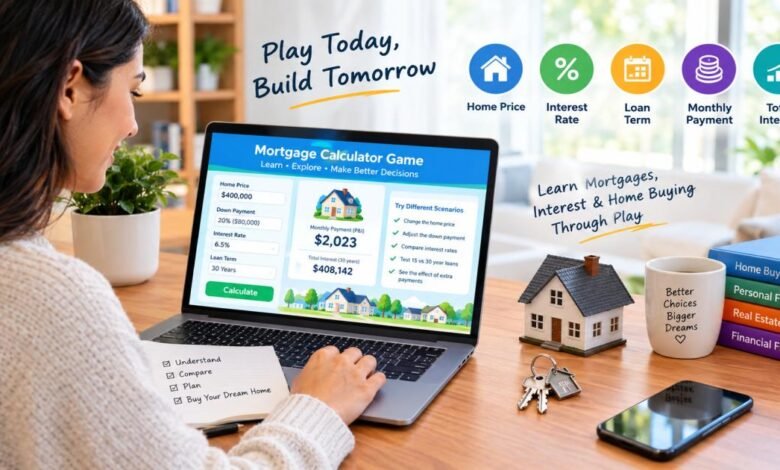
Quick answer: Mortgage calculator games are interactive tools that let you practice home loan math. You enter a home price, down payment, interest rate, and loan term. The tool shows your monthly payment and total cost. You change one input at a time and see the result right away.
Take a $350,000 home with 20% down and a 6.5% rate on a 30-year loan. The principal and interest payment is $1,769.79 a month. Total interest comes to $357,125, which is more than the $280,000 you borrowed. A mortgage payment calculator game puts that gap on your screen in seconds, with no risk.
This guide covers how these games work, what they teach, where they fall short, and how to use them before you buy. Every rate here is a sample, not today’s rate. Check current rates with a lender.
Key takeaways
- A one-point rate rise (6% to 7%) adds about $184 a month and about $66,000 in interest on a $280,000 loan.
- A 15-year loan at 5.75% costs about $555 more per month than a 30-year loan at 6.5%, but it saves about $218,600 in interest. (15-year rates typically run lower than 30-year rates.)
- An extra $200 a month cuts more than seven years off the loan and saves about $101,000.
- A game gives an estimate. A lender’s Loan Estimate gives the real numbers.
What Are Mortgage Calculator Games?
A mortgage calculator game is an interactive tool or activity that teaches home loan math through practice instead of reading.
They come in two forms. Some are calculators with game features, such as sliders, scores, and challenges. Others are simulations where you play a home buyer and make choices.
You can also build your own. Write down a guess for the payment on a $280,000 loan at 6.5% for 30 years. Then check it with any calculator. The gap between your guess and the answer shows what you still need to learn.
These tools are not lenders. They cannot approve you for a loan or give you a quote. First-time buyers, students, teachers, and parents use them to build a feel for the numbers.
How Do Mortgage Calculator Games Work?
They take four inputs, run a standard loan formula, and show your payment and total cost. Then you adjust the inputs and run it again.
Entering a Home Price and Down Payment
Start with a home price. We will use $350,000.
Next, set the down payment, the cash you pay up front. At 20%, that is $70,000. Your loan is the rest: $280,000. A smaller down payment means a bigger loan, a bigger payment, and more interest.
Choosing an Interest Rate and Loan Term
The interest rate is the yearly cost of borrowing, shown as a percent. The loan term is how long you have to repay.
In the U.S., 30-year and 15-year loans are the most common. Freddie Mac publishes average U.S. rates every week, which gives you a starting point for realistic inputs. Rules differ elsewhere. In Canada and the UK, buyers typically lock a rate for two to five years, then renew at the going rate. A good game tells you which rules it uses.
Calculating Monthly Mortgage Payments
The game feeds your inputs into the standard loan formula. For $280,000 at 6.5% over 30 years, principal and interest come to $1,769.79 a month. That figure leaves out taxes and insurance, which we cover below.
Comparing Total Interest and Loan Costs
Multiply that payment by 360 months and you pay about $637,125. About $357,125 of it is interest. Seeing interest exceed the loan itself is the moment most people understand why rate and term matter.
Testing Different “What-If” Scenarios
Change one input and compare:
- Rate drops to 6%: the payment falls to $1,678.74, which saves $91 a month and about $32,800 in total interest.
- Down payment drops to 10%: the loan grows to $315,000 and the payment rises to $1,991.01, about $221 more each month.
- Term shrinks to 15 years at 5.75%: the payment rises to $2,325.15, but total interest falls to about $138,500.
Each test answers a question you might otherwise guess at.
What Can You Learn From Mortgage Calculator Games?
You learn how principal, interest, rate, term, down payment, and extra payments shape what you owe. Here is each lesson with real numbers.
Principal vs. Interest
Principal is the amount you borrowed. Interest is the fee the lender charges for the loan.
On our sample loan, the first payment of $1,769.79 splits into $1,516.67 of interest and $253.12 of principal. Over the first year, you pay about $18,108 in interest and only about $3,130 in principal. This split is called amortization. Early payments mostly cover interest, and later payments mostly cover principal.
How Interest Rates Affect Payments
A small rate change creates a large cost change. Here is the same $280,000, 30-year loan at three rates:
| Interest rate | Monthly payment (P&I) | Total interest |
| 6.0% | $1,678.74 | $324,347 |
| 6.5% | $1,769.79 | $357,125 |
| 7.0% | $1,862.85 | $390,625 |
Moving from 6% to 7% adds about $184 a month and about $66,000 in interest over the life of the loan.
How Loan Terms Change Total Interest
A shorter loan costs more each month and far less overall. Compare the same $280,000 loan:
- 30 years at 6.5%: $1,769.79 a month, about $357,125 in interest
- 15 years at 5.75%: $2,325.15 a month, about $138,527 in interest
The 15-year loan adds about $555 a month and saves about $218,600. Part of that saving comes from the lower rate, so a game that lets you set each rate separately shows the trade-off more honestly.
The Impact of a Larger Down Payment
More cash up front shrinks the loan. Here is the $350,000 home at 6.5% over 30 years:
| Down payment | Loan amount | Monthly payment (P&I) | Total interest |
| 5% ($17,500) | $332,500 | $2,101.63 | $424,085 |
| 10% ($35,000) | $315,000 | $1,991.01 | $401,765 |
| 20% ($70,000) | $280,000 | $1,769.79 | $357,125 |
Going from 5% to 20% down cuts the payment by about $332 a month and total interest by about $67,000. The table holds the rate constant. In real life, a small down payment often adds mortgage insurance and can raise your rate.
How Extra Payments Can Reduce Interest
Extra money paid toward principal shortens the loan. Here are the results on the $280,000 loan at 6.5%:
| Extra each month | Payoff time | Total interest | Interest saved |
| $0 | 30 years | $357,125 | None |
| $100 | About 25 yrs 9 mos | $296,911 | About $60,200 |
| $200 | About 22 yrs 9 mos | $255,841 | About $101,300 |
| $300 | About 20 yrs 5 mos | $225,613 | About $131,500 |
Before you try this in real life, ask your lender whether extra payments go straight to principal and whether the loan has a prepayment penalty.
Building Home Equity Over Time
Home equity is your home’s value minus what you owe. On our sample loan, the balance falls slowly at first:
- After 1 year: $276,870 left
- After 5 years: $262,111 left
- After 10 years: $237,373 left
- After 20 years: $155,863 left
After five years, you have repaid about $17,889. Add your $70,000 down payment, and your equity is about $87,889, assuming the home’s value stays flat. Real values rise and fall, and no game can predict that.
Mortgage Calculator Games vs. Traditional Mortgage Calculators
Games teach why a payment changes. Traditional calculators give a fast estimate. Both run the same core math.
| Mortgage calculator games | Traditional calculators | |
| Main purpose | Teach and build intuition | Estimate a payment |
| Format | Sliders, challenges, scores | Forms and fields |
| Feedback | Instant, often with tips | Numbers only |
| Detail level | Often simplified | Often includes taxes, insurance, and fees |
| Best use | Learning the basics | Planning a real purchase |
Use a game to learn. Use a full calculator to plan. Use a lender’s quote to decide.
The Most Useful Types of Mortgage Calculator Games
Features vary by tool, so look for these types rather than specific brands.
Monthly Payment Guessing Games
You see a price, rate, and term, and you guess the payment before the reveal. Guess the payment on a $280,000 loan at 6.5% over 30 years, then compare it with $1,769.79. Repeating this trains your sense of what a loan really costs.
Interest Rate Comparison Games
These show two rates side by side on one loan. Compare 6% and 7% on $280,000: $1,678.74 against $1,862.85. The monthly gap looks small, but the lifetime gap passes $66,000.
Loan Term Comparison Games
You compare 15, 20, and 30 years. The best versions show monthly payment and total interest together, so you see both costs at once.
Down Payment Challenges
You set a savings target, such as $70,000 for 20% down on a $350,000 home. Then you drop to $35,000 and see the loan grow to $315,000 and mortgage insurance enter the picture.
Mortgage Payoff and Extra-Payment Simulations
You slide an extra payment from $0 to $200 and watch the payoff date move from year 30 to about year 22 and nine months. The visible reward keeps many players experimenting.
Home Affordability Games and Simulations
You enter income, debts, and savings, then choose homes you can or cannot afford. These are the closest to real life because they force you to balance wants against limits.
How to Play a Mortgage Calculator Game: A Simple Example
Open any game or calculator that lets you change the inputs, and follow along.
Step 1: Choose a Hypothetical Home Price
Pick a price that fits your area. We will use $350,000.
Step 2: Set the Down Payment
Choose 20%, which is $70,000. Your loan is $280,000.
Step 3: Select the Interest Rate
Use a sample rate of 6.5%. Real rates depend on your credit score, down payment, loan type, and the market.
Step 4: Choose a Mortgage Term
Start with 30 years.
Step 5: Compare the Monthly Payment
Principal and interest come to $1,769.79. Now add the other costs. A property tax rate of 1.1% adds about $321 a month. Insurance at $1,800 a year adds $150. The full monthly cost is about $2,241.
Step 6: See How Your Choices Change the Total Cost
On the loan alone, you pay about $357,125 in interest over 30 years. Switch to 15 years and compare. Then add $200 a month. Write down each result. That list becomes your own cheat sheet.
Mortgage Calculator Games for First-Time Homebuyers
A mortgage game for first-time buyers answers one question before you meet a lender: how much house can I handle?
First-time buyers face new terms and large numbers at once. A game lets you test those numbers privately. Try three home prices, three down payments, and a rate one point higher than you expect. If the higher rate breaks your budget, you have found a risk early.
When you move to real numbers, use official help. In the U.S., HUD-approved housing counselors give free or low-cost guidance, and the Consumer Financial Protection Bureau (CFPB) publishes free buyer guides and a rate-checking tool.
Can Mortgage Calculator Games Actually Improve Financial Literacy?
They improve your understanding of mortgage concepts. They do not guarantee better money habits.
Games work well for concepts. When you drag a rate slider and watch total interest jump, the connection between rate and cost sticks. Research on financial education typically shows small effects on behavior, though. Knowing a concept does not always change what people do.
The best results come from pairing play with action. Play the game, then check your own budget. Learn the idea, then set a savings target.
What Mortgage Costs Should a Game Include?

A complete mortgage game includes principal, interest, property taxes, homeowners insurance, PMI when it applies, HOA fees, and closing costs. Here is our sample monthly cost:
| Cost | Sample monthly amount |
| Principal and interest | $1,769.79 |
| Property tax (1.1% a year) | About $321 |
| Homeowners insurance ($1,800 a year) | $150 |
| PMI (20% down, so none) | $0 |
| Total | About $2,241 |
Principal and Interest
This is the core payment. It repays your loan and pays the lender’s fee.
Property Taxes
Local governments set these. U.S. effective rates typically range from well under 1% of home value to above 2%, depending on the state and county. Taxes can also rise when your home is reassessed.
Homeowners Insurance
Lenders require it. Cost depends on location, home age, and local risks like storms. Flood insurance is usually a separate policy.
Private Mortgage Insurance (PMI)
PMI typically applies to conventional loans with less than 20% down. It protects the lender, not you. Annual cost is typically about 0.5% to 1.5% of the loan. On a $315,000 loan, 0.5% to 1% adds about $131 to $263 a month.
Under the U.S. Homeowners Protection Act, you can ask to cancel PMI when your balance reaches 80% of the home’s original value. It usually ends on its own at 78%. FHA loans use a different insurance system with different rules.
HOA Fees
Homeowners association fees go to the community, not the lender. Lenders still count them when they judge what you can afford. Fees range from under $100 to several hundred dollars a month.
Closing Costs and Other Upfront Expenses
Closing costs typically run 2% to 5% of the loan. On $280,000, that is about $5,600 to $14,000. Add moving costs, repairs, and an emergency fund to see the true cash you need.
Common Mistakes to Avoid When Using Mortgage Calculator Games
Treating a Game Result as a Real Loan Quote
A game estimates. A lender quotes. In the U.S., lenders must give you a Loan Estimate within three business days of your application. Compare those documents, not game results, when you shop for a loan.
Ignoring Taxes, Insurance, PMI, and Other Costs
If a game shows only principal and interest, your real payment will run higher. In our example, the missing costs add about $471 a month.
Assuming the Interest Rate Will Stay the Same
Fixed-rate loans hold one rate. Adjustable-rate loans do not, and in Canada and the UK, rates reset when each term ends. Test a rate one or two points higher to see if you could still pay.
Focusing Only on the Monthly Payment
A 30-year loan lowers the monthly payment but raises total interest. In our example, the 30-year option costs about $218,600 more in interest than the 15-year option. Always read both numbers.
Comparing Loans Without Using the Same Assumptions
Change one input at a time. If you alter price, rate, and down payment together, you cannot tell which change moved the result. Keep taxes, insurance, and fees the same across your tests.
How Accurate Are Mortgage Calculator Games?
The math is typically accurate. The inputs are the weak point.
Most tools use the standard loan formula, so the same inputs should give the same payment everywhere. You can check this yourself. Enter $280,000 at 6.5% for 30 years into two different tools. Both should show about $1,769.79 for principal and interest. If they disagree, one tool uses different rules.
Accuracy drops when inputs are guesses. A wrong tax rate, a missing insurance cost, or an assumed fixed rate can move the real payment by hundreds of dollars a month. Treat every result as a range, not a promise.
How we calculated the numbers: all figures in this guide use the standard fixed-rate amortization formula with monthly payments and the sample inputs stated in each section.
Mortgage Calculator Games for Students and Financial Education
These games fit personal finance classes, youth programs, and family lessons. A free calculator and a clear goal are enough. Try these formats:
- Guess and check: Students guess a payment, then check it.
- Team challenge: Each team picks a down payment and term. The lowest total cost wins, but only if the monthly payment stays within a set budget.
- Rate shock: Raise the rate by one point and discuss what changes.
- Budget project: Give each student an income and debts, then ask them to pick a home they can afford.
Older students can go one step further and build the payment formula in a spreadsheet to see how the tools work inside.
How to Use Mortgage Calculator Games to Prepare for Buying a Home
Follow these six steps in order.
Start With a Realistic Home Price
Check listings in the area you want. Then check your budget. A common guideline caps housing costs near 28% of gross monthly income and total debts near 36%. At a $90,000 income, gross pay is $7,500 a month, and 28% is $2,100. Our sample home at about $2,241 would stretch that budget. These are guidelines, and lenders set their own limits.
Test Multiple Down Payment Amounts
Try 5%, 10%, and 20%. Note the loan size, payment, and PMI at each level. Then decide how much cash you can spend and still keep a safety cushion.
Compare Different Interest Rates
Test the rate you hope for and one point higher. If the higher payment still fits, you have room for surprises.
Compare 15-Year and 30-Year Mortgages
Look at monthly payment and total interest together. Decide which matters more to you now: lower monthly cost or lower total cost.
Test Extra Monthly Payments
Try $50, $100, and $200 extra. Check how much time and interest you save, and ask yourself whether you could keep paying it every month.
Compare Monthly Affordability With Total Loan Cost
A loan can feel easy each month and still cost far too much overall. Another can cost less overall but squeeze your budget. Check both before you commit.
Mortgage Calculator Games: Pros and Cons
Advantages
- They show how rate, term, and down payment connect.
- They give instant feedback, so you learn by trying.
- They carry no risk, so mistakes cost nothing.
- Many run free in a browser or on a phone.
- They suit students, parents, and first-time buyers.
- They show how small changes add up. One extra point of interest adds about $66,000 in our example.
Limitations
- Results are estimates, not quotes.
- Some tools skip taxes, insurance, PMI, or fees.
- Many assume one fixed rate for the whole loan.
- Rules differ by country and loan type.
- They cannot judge your credit or full finances.
- A fun design can hide missing detail, so check each tool’s settings.
Final Thoughts
Mortgage math comes down to four numbers: price, down payment, rate, and term. Mortgage calculator games let you move those numbers until the connections make sense.
Start with one home price and change one input at a time. Write down what you see. Then add taxes, insurance, and fees to see the true monthly cost. When you are ready for real figures, take your notes to a lender or housing counselor. You will ask sharper questions and spot weak offers faster.
FAQs
What are mortgage calculator games?
Mortgage calculator games are interactive tools that let you practice home loan math. You enter a home price, down payment, interest rate, and loan term. The tool shows your monthly payment and total cost, and you change inputs to see how each one affects the result.
Are mortgage calculator games free?
Many are free to use in a browser. Some include ads or paid upgrades. You do not need to pay to learn the basics, because any free mortgage calculator works as a “guess and check” game.
Are mortgage calculator games accurate?
The math is typically accurate when a tool uses the standard loan formula. Accuracy depends on your inputs. Missing taxes, insurance, PMI, or a changing rate can make your real payment differ by hundreds of dollars a month.
Can I learn mortgage interest through a game?
Yes. A game shows how interest builds over time. On a $280,000 loan at 6.5%, about $1,517 of your first $1,770 payment goes to interest. Watching that split shift over the years makes amortization clear.
Can mortgage calculator games calculate real mortgage payments?
They can estimate them. With real inputs, principal and interest will land close to your lender’s figure. Your lender’s Loan Estimate adds exact taxes, insurance, and fees, so use it for any real decision.
Are mortgage calculator games suitable for students?
Yes. They work well for high school and college personal finance classes. Students can compare loan terms, test rate changes, and build a budget project with no special software.
Do mortgage calculator games replace a real mortgage calculator?
No. Use a game to learn the concepts. Use a full calculator to plan with taxes and insurance. Use your lender’s official quote to make the final choice.